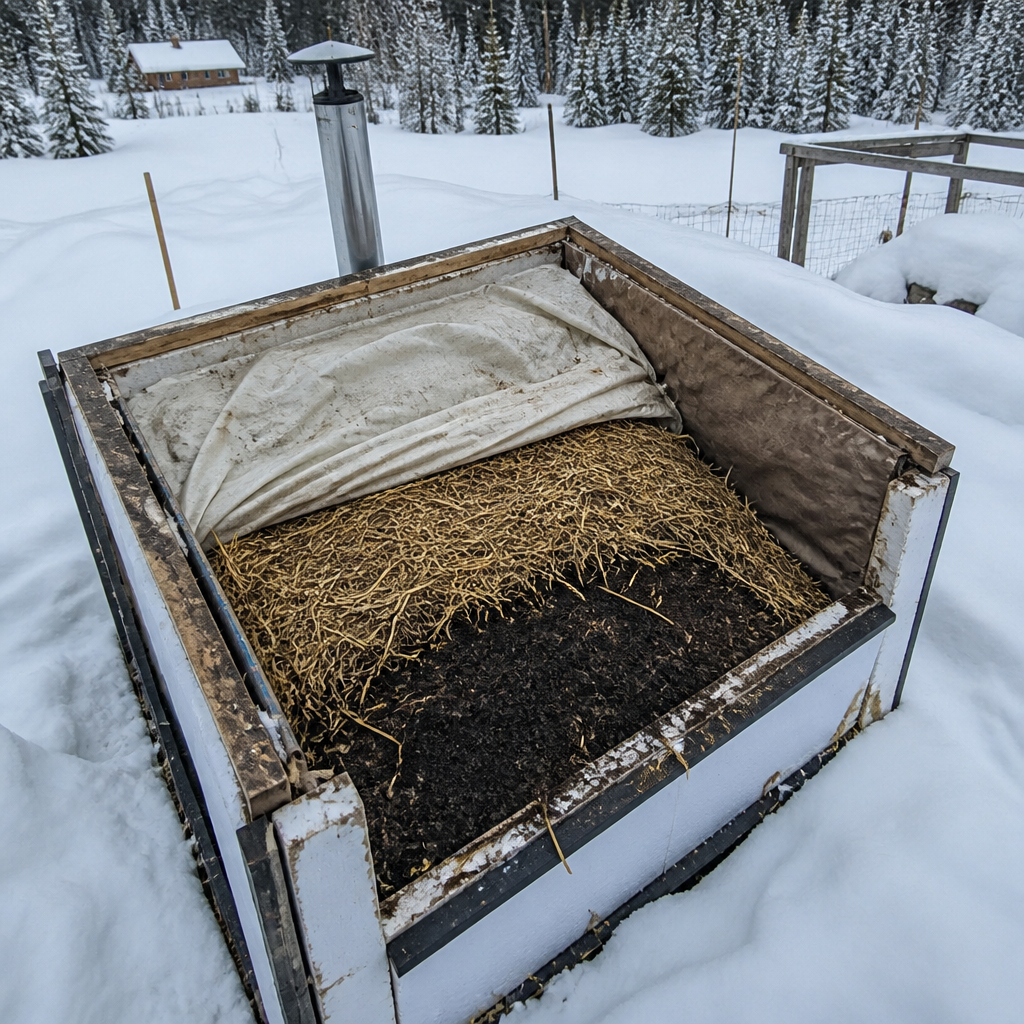
Most Canadian homesteaders treat their compost pile the same way they treat the garden: shut it down in October and hope for the best in May. That is a significant mistake. A pile that sits idle all winter means no finished compost ready when your beds need it most, and a mountain of kitchen scraps with nowhere to go during the coldest months of the year. Composting in a cold climate is not only possible, it is one of the highest-return habits you can build on a self-sufficient homestead. The biology does slow down, but it never has to stop entirely, and with the right setup you can walk into spring with a bin full of finished, garden-ready material.
Table of Contents
- Why Winter Composting Matters for Off-Grid Homesteads
- Quick Takeaways
- The Science Behind Cold Compost: What Actually Happens Below Freezing
- Location and Bin Setup: Getting the Fundamentals Right Before First Frost
- Insulating Your Pile: Practical Methods That Work in Canadian Winters
- Maintaining the Carbon-to-Nitrogen Balance Through Winter
- Comparing Winter Composting Methods: Outdoor Pile vs. Tumbler vs. Vermicomposting
- Managing Kitchen Scraps During Deep Freeze Periods
- Spring Reactivation: How to Wake Your Pile Up Fast
- Frequently Asked Questions
- References
Why Winter Composting Matters for Off-Grid Homesteads
On an off-grid property, waste has to go somewhere. You are not connected to municipal curbside pickup, and hauling organic scraps off-site defeats the entire point of a closed-loop homestead. Winter composting solves a real logistical problem, not just an idealistic one.
Beyond waste management, keeping your pile active through winter means your compost continues breaking down for five or six additional months every year. That is the difference between having rich, crumbly finished compost available for transplanting in May and scrambling to amend beds with half-processed material. Sustainable soil building on a homestead is a year-round commitment, not a seasonal one.
There is also a less obvious benefit: a large, active compost pile generates real heat. A well-managed outdoor pile can reach internal temperatures high enough to support a cold frame or insulate a nearby root cellar wall. For off-grid homesteaders in Zones 2 through 4, that is a resource worth capturing.
Quick Takeaways
| Key Insight | Explanation |
|---|---|
| Cold slows decomposition, it does not stop it | Psychrophilic bacteria remain active even near freezing, keeping decomposition ticking at a slower rate. Only a completely frozen pile halts the process entirely. |
| Pile size is your most powerful tool | A larger pile generates and retains more heat. Aim for a minimum of one cubic metre to maintain internal warmth through a Canadian winter. |
| Stock your browns in fall or you will struggle all winter | Dry leaves, straw, and woody debris disappear under snow. Bag or store a large supply before freeze-up so you can balance your greens through February and March. |
| Insulation beats turning in winter | Turning a cold pile releases the internal heat you have worked to build. Insulate with straw bales, leaf bags, or cardboard instead, and wait until spring to turn. |
| Location chosen in October matters in January | A south-facing, wind-sheltered spot absorbs solar heat and avoids the worst cold. Moving a frozen pile mid-winter is not realistic. |
| Vermicomposting indoors runs year-round without interruption | A worm bin kept between 55 and 77 degrees Fahrenheit processes kitchen scraps continuously and produces castings ideal for seed-starting mixes in late winter. |
| Even a frozen pile is still doing something useful | Freeze-thaw cycles physically break down cell walls in organic material, making it easier for microbes to process the material rapidly once temperatures rise in spring. |
The Science Behind Cold Compost: What Actually Happens Below Freezing
Understanding what is happening inside your pile in January changes how you manage it. Most homesteaders assume the pile is dead. It is not, or at least it does not have to be.
Thermophilic vs. Psychrophilic Bacteria
A hot, active summer pile is dominated by thermophilic bacteria, which thrive at internal temperatures between roughly 113 and 167 degrees Fahrenheit. Once the pile cools below 68 degrees Fahrenheit, a different class of microorganisms, called psychrophilic bacteria, takes over the decomposition work. They operate more slowly, but they are genuinely active and they generate small amounts of heat, which helps the core of a well-insulated pile resist freezing solid.
The only condition that fully stops decomposition is a pile that is frozen completely through, from surface to core. A pile with an insulated exterior and a large enough mass will maintain an unfrozen core even when air temperatures drop well below zero Celsius. That core is where the biological work continues all winter.
Why Freeze-Thaw Cycles Are Not a Total Loss
If your pile does freeze partially or even fully during a deep cold snap, that is not a catastrophe. Repeated freeze-thaw cycles physically rupture the cell walls of organic materials, breaking them into smaller particles and making them significantly easier for microbes to process once temperatures recover. A pile that spent January frozen and February thawing will often decompose very rapidly in March. The biology is not wasted, it is just deferred.
A compost pile is not a machine you switch off for winter. It is a living system that adapts its pace to conditions. Your job is to keep conditions favorable enough that it never has to stop completely.
Location and Bin Setup: Getting the Fundamentals Right Before First Frost
The decisions you make in September and October determine how hard your winter is going to be. Trying to correct a bad location after freeze-up is not practical.


Where to Place Your Bin
Place your compost bin in a south-facing, wind-sheltered position. A corner formed by two walls, a fence adjacent to a shed, or the south side of a woodshed all work well. This positioning allows the pile to absorb passive solar heat during the short winter daylight hours and protects it from the prevailing wind that strips heat away. Keep the bin close enough to your house that you will actually use it in January. A compost bin that requires a long, icy walk through a snowdrift gets ignored, and ignored bins become a problem.
Minimum Size for Canadian Winters
Size matters more in winter than at any other time of year, because a larger pile generates and retains more internal heat. A pile that is too small will freeze solid within weeks of the first hard frost. For Canadian winters, particularly in Zones 3 through 5, target a minimum volume of one cubic metre, roughly a metre wide, a metre deep, and a metre tall. Bigger is better. On an off-grid homestead with livestock, garden waste, and kitchen scraps, reaching that volume is rarely the problem. The problem is usually losing it to turning too often.
Pro tip: Build your pile to full size in October before adding any insulation. A full pile insulated before hard frost hits will maintain an active core weeks longer than a pile that was small in October and then built up gradually through November.
Insulating Your Pile: Practical Methods That Work in Canadian Winters
Insulation is the single most effective intervention for winter composting in a cold climate. It is more impactful than additives, more practical than heating elements, and it costs nothing if you already produce straw or store leaves.
Straw Bale Perimeter
Stack straw bales around the sides of your bin to create a thermal buffer. Straw is an excellent insulator because it traps air without blocking moisture exchange the way solid walls do. This approach works for both three-sided wooden bins and freestanding piles. If you are on a homestead with livestock, your hay and straw supply means this material is already on-site. In spring, the straw bales can go directly into the garden as mulch or be chopped into the pile as carbon material.
Leaf Bags and Cardboard Lining
Bags of dry autumn leaves placed around and on top of the bin serve the same function as straw bales. Lining the inside of a slatted or thin-walled bin with corrugated cardboard adds an additional insulating layer. For the top of the pile, a layer of burlap, an old wool blanket, or a heavy dark-colored tarp holds heat in and keeps excess snowmelt from waterlogging the pile. A dark cover also absorbs solar heat on clear winter days, which can meaningfully raise the surface temperature of the material underneath.
Do Not Turn in Winter
This is the counterintuitive piece that trips up many homesteaders. Turning a compost pile releases its internal heat rapidly into the cold air. In summer, turning is valuable because it reintroduces oxygen and redistributes heat. In winter, the priority is retaining whatever heat the pile has generated. Leave the pile alone from December through February. Wait until the pile has fully thawed in spring, then turn it thoroughly to restart active thermophilic decomposition.
Pro tip: Ring the inside of your bin with six to twelve inches of dry leaves, sawdust, or wood chips before adding your fall material. This creates a built-in insulating wall that stays in place all winter and requires no external bales or bags.
Maintaining the Carbon-to-Nitrogen Balance Through Winter
The carbon-to-nitrogen ratio does not stop mattering in winter. In fact, it becomes harder to manage because most of your brown material, dry leaves, straw, and plant debris, is produced in fall and may be buried under snow or decomposed into the pile by January.
Stock Browns Before Freeze-Up
This is the single most important preparatory step for winter composting in Canada. Bag a large quantity of dry autumn leaves in October and store them in a dry location near the bin, a shed corner, a covered area, or even an empty livestock stall. Plan to add a layer of brown material each time you add kitchen scraps to the pile through winter. Without this stored supply, you will be adding green-heavy material all winter and the pile will go sour, wet, and anaerobic.
What Counts as Green in Winter
Your kitchen will continue producing nitrogen-rich organic waste all winter: vegetable peels, fruit scraps, coffee grounds, eggshells, and cooked grain and legume waste. These are your greens. On a homestead with animals, manure from chickens, rabbits, and small livestock is also a powerful green additive that raises internal pile temperatures significantly. Fresh manure added to a well-insulated winter pile can keep the core actively decomposing even during extended cold snaps.

Comparing Winter Composting Methods: Outdoor Pile vs. Tumbler vs. Vermicomposting
There is no single correct approach for every homestead. Your available space, waste volume, and tolerance for cold-weather maintenance will determine which method or combination of methods works best. Here is how the three main options compare for Canadian winter conditions.
| Method | Winter Performance in Cold Climates | Best Suited For |
|---|---|---|
| Outdoor Insulated Pile | Maintains active core if pile is large enough (1+ cubic metre) and properly insulated with straw bales or leaf bags. Slows significantly but rarely freezes solid in the core. Best long-term production. | Homesteads with high waste volume, access to straw or leaves, and space for a large pile. The default choice for off-grid properties. |
| Compost Tumbler | Smaller volume means it freezes faster than a large outdoor pile. Loses heat quickly when turned. Can be kept active if placed in a sheltered spot and turned only on warmer days. Dual-chamber models allow one side to rest while the other receives new material. | Smaller properties or homesteaders who need pest resistance. Works best as a supplement to a larger pile rather than a standalone winter solution. |
| Indoor Vermicomposting | Fully temperature-independent when kept indoors. Operates continuously at room temperature year-round. Produces nutrient-dense worm castings ideal for seed-starting mixes in late winter and early spring. | Any homestead with space for a bin indoors. Excellent for processing kitchen scraps during periods when the outdoor pile is frozen or inaccessible. Handles smaller volumes than an outdoor pile. |
The most resilient winter composting system on a Canadian homestead combines a large, insulated outdoor pile for bulk material with an indoor worm bin for daily kitchen scraps. The worm bin handles the high-frequency, small-volume work through the coldest weeks, while the outdoor pile processes larger material and builds the bulk of finished compost for spring use.
Managing Kitchen Scraps During Deep Freeze Periods
Even a well-insulated outdoor pile can become inaccessible during a genuine deep freeze. In central and northern Canada, temperatures can drop far enough for long enough that the surface of the pile freezes hard and adding material becomes difficult.
The Staged Addition Approach
Rather than making daily trips to the compost bin through January and February, collect kitchen scraps in a sealed container in the kitchen, a five-gallon bucket with a lid works well, and add the accumulated batch once a week. This reduces the number of cold trips and allows you to add a proper layer of browns at the same time, maintaining the balance rather than just dumping greens on top every day.
Freezing Scraps as a Strategy
On a homestead with a cold mudroom or unheated outbuilding, freezing kitchen scraps temporarily is a practical buffer strategy. Scraps can accumulate in a frozen state for weeks and then be added to the outdoor pile in a single large addition during a milder stretch. The freeze-thaw process that the scraps undergo actually helps break them down faster once they hit the pile. This is not a workaround, it is a legitimate technique for managing high-volume winter waste on remote properties.
What Not to Add in Winter
Avoid adding large amounts of wood ash to the compost pile in winter. Wood ash raises the pH of the pile significantly, and at elevated pH levels microbial activity drops. On a woodstove-heated off-grid homestead, wood ash is abundant in winter, but spread it directly on garden beds or use it selectively rather than dumping it into the compost. Meat, cooked fats, and dairy should be kept out of open outdoor piles year-round, not just in winter, to avoid attracting wildlife to the property.
Spring Reactivation: How to Wake Your Pile Up Fast
The payoff for all of your winter maintenance work comes in March and April. A pile that was fed and insulated through winter will not need months to get active again. It needs the right conditions and a little help.
Remove Insulation Early
As soon as daytime temperatures consistently stay above freezing, remove the straw bales or leaf bags from around the bin. Exposing the pile to direct spring sunlight accelerates thawing significantly. Resist the urge to turn the pile until it is fully thawed through. Turning a partially frozen pile does more harm than good, it exposes frozen material to air before the biology has restarted.
Turn and Activate Once Thawed
Once the pile is fully thawed, give it a thorough turning. This reintroduces oxygen, redistributes moisture, and mixes partially decomposed surface material with the more broken-down core. Add a nitrogen-rich activator if available: fresh chicken manure, freshly cut grass, or a batch of kitchen scraps are all effective. The pile should heat up rapidly within a few days of the first proper turning, often reaching active temperatures within a week.
Homestead compost tips do not get more impactful than this: the pile you manage well through winter is the pile that produces finished compost by late May, six to eight weeks earlier than a pile that was abandoned and restarted from scratch in spring. On a short-season Canadian growing schedule, those weeks matter enormously for transplanting, bed preparation, and early season fertility.
Frequently Asked Questions
Will my compost pile just freeze solid in a Canadian winter?
It depends almost entirely on pile size and insulation. A pile smaller than roughly one cubic metre with no insulation will likely freeze solid in most Canadian winters. A pile at or above that volume, surrounded by straw bales or leaf bags, will typically maintain an unfrozen, biologically active core through all but the most extreme cold snaps. The core is where decomposition continues, even when the surface is frozen hard.
Should I keep turning my compost pile through winter?
No. Turning a compost pile in winter releases the internal heat the pile has worked to generate, and that heat cannot be recovered quickly in cold conditions. Leave the pile undisturbed from the onset of hard frost until it has fully thawed in spring. Your first turn of the season in spring will accomplish far more than any number of winter turns, and it will not cost you heat loss at the worst possible time.
What is the best way to handle kitchen scraps when the outdoor pile is frozen solid?
Collect scraps in a sealed bucket indoors and add them in weekly batches rather than daily trips. If the pile surface is frozen hard, you can also freeze scraps in an unheated outbuilding and add the thawed batch during a mild stretch. For continuous processing, an indoor worm bin is the most reliable option. It handles kitchen scraps year-round at room temperature and does not depend on outdoor temperatures at all.
Can I use a compost tumbler for winter composting in Canada?
A tumbler can work in a Canadian winter, but it is not the strongest choice as a standalone system. Tumblers have a smaller volume than open piles, which means they freeze faster and lose heat more quickly when turned. Place the tumbler in a sheltered, south-facing location, insulate it with a wrapped tarp or foam board if possible, and only turn it on milder days above freezing. A tumbler works best as a supplement to a larger outdoor pile or worm bin rather than your only winter composting system.
Is it worth keeping the compost active all winter or should I just start fresh in spring?
Keeping it active is worth it. A pile that is maintained through winter, even at a reduced pace, produces finished compost significantly earlier in spring than a pile abandoned and restarted in April. On a Canadian homestead with a short growing season, having finished compost available in May rather than July is a practical advantage that directly improves your garden yield. The effort required to maintain a winter pile is modest: store your browns in fall, add material in weekly batches, insulate well, and leave the pile alone until spring.
Can I compost manure from my livestock through winter?
Yes, and livestock manure is one of the best additions to a winter compost pile. Fresh manure from chickens, rabbits, or small livestock is high in nitrogen and generates significant heat when added to a pile. It can keep the core of a large pile actively decomposing even during sustained cold. Layer it with your stored browns the same way you would kitchen scraps, and it will accelerate decomposition and maintain internal pile temperatures better than kitchen scraps alone.
If you are managing winter composting on your homestead right now, share what is working and what is not in the comments. Every Canadian property and climate zone throws up slightly different challenges, and this community learns best from real-world experience.
We would love your feedback and any insights you would share with others. What perspective would you add?
References
- Eartheasy: Tips for keeping outdoor compost active through winter, including carbon-nitrogen balance and bin management in cold seasons
- University of Illinois Extension: The science of microbial activity in cold compost, thermophilic and psychrophilic bacteria behavior
- University of New Hampshire Extension: Practical guidance on insulating compost bins and managing winter composting without turning
- The Homestead Challenge: Cold-climate composting strategies including tumbler use, insulation methods, and pile location
- Trochu Arboretum: Composting in Alberta’s cold climate with bin placement and layering techniques for Canadian conditions
Leave a Reply