A burst pipe at -30°C, no municipal repair crew to call, and a cistern that stopped flowing two days ago. This is not a hypothetical for Canadian homesteaders. It is a real emergency that happens every winter to people who skipped even one step when winterizing their off-grid water system. The stakes are different when you are your own water utility. There is no backup. This guide covers every layer of protection your pipes, pumps, and cisterns need before the ground freezes solid, with specific attention to the deep-cold conditions that define Canadian off-grid living.
Table of Contents
- Why Off-Grid Water Systems Fail in Winter
- Quick Takeaways
- Pipe Insulation and Burial Depth: Getting the Numbers Right
- Protecting Your Pump: Well Pumps, Hand Pumps, and Ram Pumps
- Winterizing Your Cistern: Underground, Partially Buried, and Above-Ground
- Heat Tape and Active Heating: When Passive Methods Are Not Enough
- Drain-Back Systems and Seasonal Shutdown
- Comparison of Freeze Protection Methods
- Building a Winter Water Backup Plan
- Frequently Asked Questions
- References
Why Off-Grid Water Systems Fail in Winter
Water expands by roughly 9 percent when it freezes. Inside a pipe, that expansion generates tremendous outward pressure on the pipe walls, which is what causes them to crack or burst. The pipes at greatest risk are those exposed to moving cold air – crawl spaces, unheated outbuildings, sections that run along exterior walls, and any above-ground run that lacks insulation.
On a homestead, the failure points multiply compared to a grid-tied house. You may have a spring box a hundred metres from your cabin, a poly cistern sitting partially above grade, a pressure tank in an unheated pump house, and gravity-fed lines that cannot simply be re-pressurized by calling a plumber. Understanding exactly where your system is vulnerable is the first step. Map every component before the first hard freeze: water source, storage tanks, lines, pumps, and fixtures.
Quick Takeaways
| Key Insight | Explanation |
|---|---|
| Burial depth varies dramatically by province | In Ontario’s Muskoka region, 4 feet is the minimum recommended burial depth. In northern BC, safe depth can exceed 5 feet. Always verify local frost depth before trenching. |
| Fittings and joints freeze before straight pipe runs | Elbows, tees, and compression fittings lose heat faster than straight sections. These need extra foam wrap or heat tape coverage, not just the main run. |
| A well’s water itself does not freeze | Groundwater stays below the frost line and remains liquid. What freezes is the pump head, wiring, and the supply line between well and house – these are the components to protect. |
| Cistern tops are the most vulnerable part of buried tanks | A buried cistern below the frost line will not freeze at the water body, but the top section and float switch can ice over. Insulate the lid and check float switch clearance before winter. |
| Non-toxic RV antifreeze is not just for RVs | Propylene glycol-based antifreeze is safe for use in drain traps and toilet bowls on homesteads where lines will be shut down seasonally. Never use automotive ethylene glycol antifreeze in potable water systems. |
| Heat tape must be GFCI-protected | Heat tape installed without a ground-fault circuit interrupter outlet is a fire hazard. This is non-negotiable, especially in damp pump houses or near water tanks. |
| A slow drip can prevent freezing in active systems | During extreme cold snaps below -20°C, allowing a faucet to drip slightly overnight keeps water moving and relieves pressure buildup, buying time until temperatures rise. |
Pipe Insulation and Burial Depth: Getting the Numbers Right
Burial depth is the most important variable in any off-grid water line installation, and it is also the one most often underestimated. Frost depth in Canada is not uniform. In southern Ontario, 4 feet is a widely cited minimum for areas like Haliburton and Muskoka. In northern British Columbia, safe burial depths for supply lines can reach 5 feet or more depending on the specific freezing index of the area. When a pipe passes under a driveway or wooden deck where snow cannot accumulate as natural insulation, it must go deeper than the open-ground frost depth for that region.
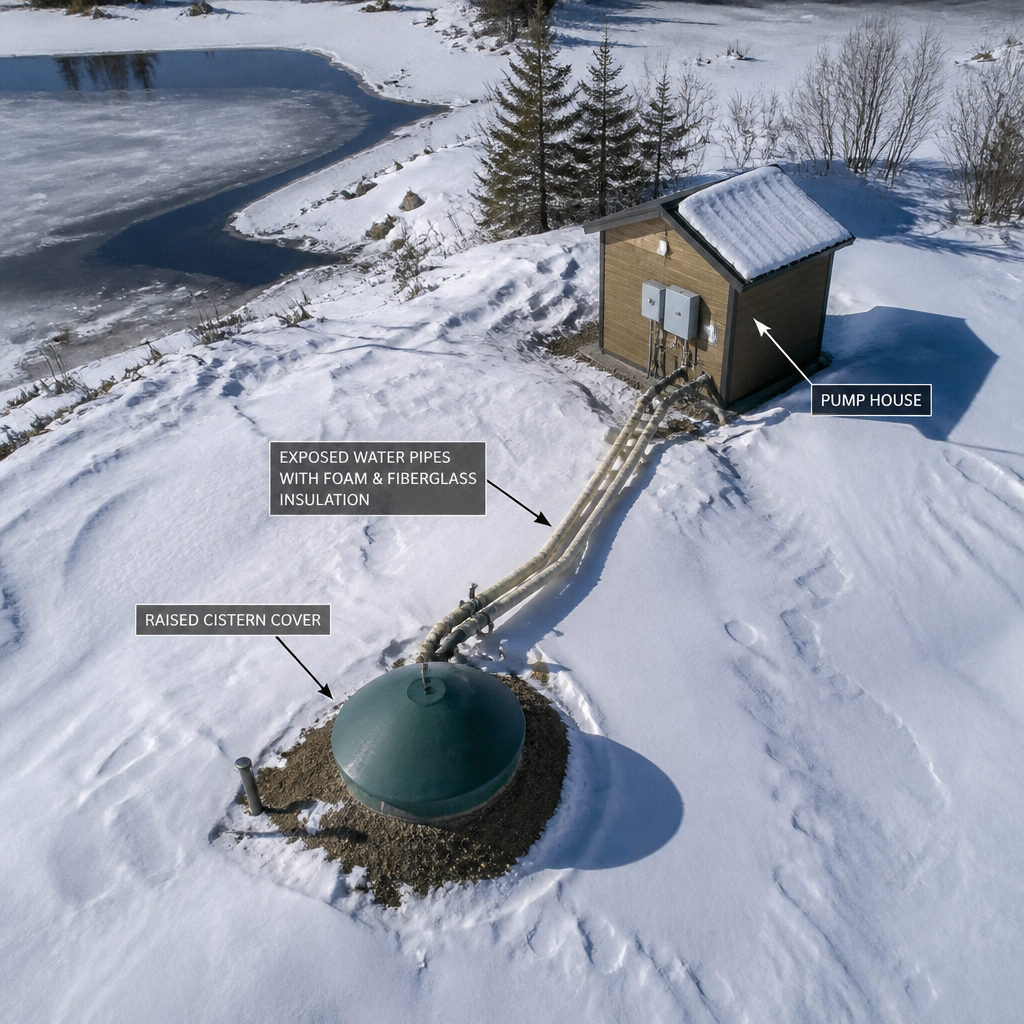
For existing lines that cannot be dug up and reburied, the practical answer is a combination of pipe insulation and heat tape. Closed-cell foam pipe insulation sleeves are the baseline. They are inexpensive, easy to cut and fit, and can be layered: a larger sleeve placed over a smaller one adds meaningful protection. Fiberglass insulation wraps work for irregular shapes. The critical rule is to cover every fitting and joint, not just the straight runs. Elbows, tees, and valve bodies are the first places a line will freeze because they have more surface area relative to their volume.
Pro tip: If a buried line must pass beneath a frost-vulnerable surface like a concrete pad with no snow cover, wrap that section with heat tape before insulating over it. The insulation alone will not compensate for the lack of ground insulation above the pipe.


Surface Pipe Runs and Exposed Lines in Outbuildings
Any pipe that runs through an unheated structure, an outbuilding, or a crawl space is at risk even if the rest of your system is buried. Insulate these runs as if they are outdoor pipes. Pay attention to where the pipe enters and exits the building envelope. Cold air travels along copper pipe, so a short exposed section near an exterior wall can freeze a long interior run that is otherwise protected. Installing a frost-proof shutoff valve on outdoor hose connections, with the actual closing valve located several inches inside the heated wall, eliminates one of the most common freeze points on any homestead.
Protecting Your Pump: Well Pumps, Hand Pumps, and Ram Pumps
The water inside a well casing does not freeze because it sits below the frost line. What fails is everything above it. For a submersible pump system, the pump motor itself generates a small amount of heat that helps the immediate area resist freezing. But the supply line leaving the well casing, the pressure switch, the pressure tank, and all associated wiring are exposed to whatever temperature exists in your pump house or utility area.
A well cap that seals the top of the casing prevents cold air from descending into the well. An insulated well house around the pump head, pressure tank, and associated plumbing is the most effective single upgrade for a surface-level pump installation. A small thermostatically controlled space heater inside the pump house provides active backup during extended cold snaps, but the enclosure itself must be tight enough to hold that heat. Check for gaps where pipes enter or exit, around vents, and at any wall penetration. Seal with caulk for small gaps and expanding foam for larger ones.
Hand Pumps for Year-Round Reliability
A properly installed hand pump can function through Canadian winters even when power fails and electric pumps freeze, because the pump body can be mounted at grade and the foot valve sits below the frost line. The pump rod and cylinder work in a zone that never freezes. This makes a deep-well hand pump one of the most valuable redundancy investments on a northern homestead. The one failure mode to watch for is a pump rod that is slightly misaligned, allowing the pump cylinder to sit too close to the frost zone. Confirm the foot valve position is at least several feet below your local frost depth.
Ram Pumps in Winter Conditions
Ram pumps present a specific winterization challenge because they operate continuously in moving surface water, which means they are exposed to the air 24 hours a day. The drive pipe and pump body should be insulated where they transition from submerged to above-grade. In turbulent water conditions, frazil ice can form at any depth and potentially block a screened intake. A settling box with a screened intake should be checked regularly through freeze-up. If your property is in a region where the source stream ices over, a ram pump may not be viable as a sole winter water source without an additional storage strategy.
Pro tip: Add a manual bypass valve to your pump setup so you can isolate and drain the pump head for inspection or maintenance without losing water from the entire system. This is especially important in winter when you need to act fast if something goes wrong.
Winterizing Your Cistern: Underground, Partially Buried, and Above-Ground
Cistern winterization strategy depends almost entirely on where the tank sits relative to the frost line. A fully buried concrete or polyethylene cistern with its top below the local frost depth will not freeze at the water body itself. The threat is at the lid, the inlet and outlet connections, and any accessories like float switches that protrude upward into the cold zone. Insulating the lid with rigid foam board and protecting the inlet and outlet lines where they exit the tank is sufficient for most fully buried installations.
Partially buried tanks are the most common problem case on homesteads because they look protected but are not. The portion of the tank above grade, even a few inches, will lose heat to the air. On a poly tank, even partial ice formation at the top can immobilize a float switch, misread water levels, and in severe cases, apply pressure to fittings. Adding rigid foam insulation around the above-grade portion and building a simple insulated skirt around the exposed section provides meaningful protection. Black polyethylene tanks absorb solar heat during daylight hours in winter, which helps somewhat, but passive solar gain at -25°C is minimal.

Above-Ground Tanks: Insulation as the Primary Defense
An above-ground tank in a Canadian winter is a serious liability without active or aggressive passive protection. The outer surface of the tank will reach ambient air temperature. For tanks used year-round, the options are: move the tank to a heated space, build an insulated enclosure around it, or install a low-wattage submersible tank heater. For seasonal systems, the correct answer is to drain the tank completely before freeze-up and flush lines with compressed air.
A cistern outlet valve sitting in an uninsulated box, even just four feet below grade, can freeze solid if the surrounding soil has dried out and lost its insulating capacity. Soil moisture matters almost as much as burial depth.
Cistern Overflow and Vent Line Protection
Overflow pipes and vent lines on cisterns are frequently overlooked in winterization. An overflow line that rises toward grade and has standing water in it will freeze and can create a back-pressure blockage. Configure overflows to drain away from the tank at a continuous downward slope with no low points where water can pool. Vent lines should have a screened cap that prevents cold-air funneling. In very cold climates, installing a small foam backer rod insert inside the vent elbow slows the cold-air column that drops into the tank.
Heat Tape and Active Heating: When Passive Methods Are Not Enough
Heat tape, also called heat cable or pipe heating cable, is an electric resistance wire that wraps around or runs alongside a pipe and maintains a temperature above freezing. It is the right tool when a pipe cannot be buried deeper, when an outbuilding cannot be fully insulated, or when a particularly exposed run of pipe is at risk despite insulation. The rule for installation is simple: run the tape in contact with the pipe surface and secure it tightly with pipe wrap tape or zip ties so the heat transfers into the pipe rather than dissipating into the air. Then insulate over the top of the heat tape.
Without insulation over the heat tape, you are heating the air around the pipe instead of the pipe itself, and you will use far more electricity for far less protection. On a solar or battery-based off-grid system, this matters a great deal. Self-regulating heat tape is the better choice for off-grid use because it automatically reduces power consumption as ambient temperature rises, preventing overheating and reducing draw on your battery bank during mild periods.
Every heat tape installation must be on a GFCI-protected outlet. In a damp pump house or near water storage, this is not optional. Heat tape installed without ground-fault protection is a documented fire and electrocution hazard.
Drain-Back Systems and Seasonal Shutdown
For homesteads or cabins that are unoccupied through the winter, a complete seasonal shutdown is often the most reliable freeze protection. The process is straightforward in principle and requires attention to detail in practice. Shut off the water supply, open every valve and tap to allow water to escape, and use a compressor to blow out any water that remains in the lines. Do not rely on gravity alone for a complex line layout with multiple low points, bends, and traps.
After blowing out the lines, add a small amount of non-toxic propylene glycol RV antifreeze to drain traps and toilet bowls. This prevents residual water in traps from freezing and cracking porcelain or plastic fittings. Do not skip this step. A blown p-trap costs almost nothing to replace, but if a cracked trap is in an inaccessible location, repair costs compound quickly. Use only propylene glycol-based antifreeze in any part of your potable water system. Ethylene glycol, the type used in vehicle radiators, is toxic.
For systems that remain active through the winter, a drain-back design routes water so that when the pump shuts off, water in exposed lines falls back into a protected storage reservoir rather than sitting in the cold portion of the line. This is an engineering decision made at installation, but existing systems can sometimes be retrofitted with strategic low-point drains and check valves to approximate this protection.
Comparison of Freeze Protection Methods
| Method | Best Application | Key Limitation |
|---|---|---|
| Deep burial below frost line | New installations and supply lines with accessible trench routes. The most permanent and power-independent solution. | Requires excavation. Minimum depth varies by location (4 to 6+ feet across Canadian provinces). Not practical for retrofitting exposed runs. |
| Foam pipe insulation plus heat tape | Existing exposed runs, pump houses, outbuildings, and partially buried tanks. Best for retrofitting where burial depth cannot be increased. | Heat tape draws power continuously in cold weather. Requires GFCI protection. Self-regulating tape reduces but does not eliminate power draw. Tape has a finite service life and must be inspected annually. |
| Full seasonal shutdown with RV antifreeze | Seasonal cabins, secondary water systems, garden irrigation lines, and any system not needed through winter. Completely eliminates freeze risk for shut-down components. | Requires complete shutdown and recommissioning each season. Not suitable for year-round water needs. Trap antifreeze must be replaced if lines are flushed before consistent above-freezing temperatures return. |
Building a Winter Water Backup Plan
Even a perfectly winterized system can fail. A power outage kills heat tape. An unexpected cold snap drops temperatures below your system’s design threshold. A fitting cracks for reasons you cannot diagnose until spring. Every off-grid homestead should have a secondary water access plan before it needs one.
The minimum backup plan is a supply of stored water inside the heated living space. For drinking and cooking, two to three days of stored water per person buys time to diagnose and address a system failure without immediate crisis. Beyond that, knowing the location of the nearest accessible water source, whether that is a neighbor’s working well, a nearby stream that does not freeze, or a municipal fill station, is essential knowledge for any remote property owner.
A properly installed deep-well hand pump on the same well as your electric submersible pump gives you year-round water access even during power outages, because the hand pump operates entirely independently of your electrical system. This is one of the most cost-effective redundancy investments available for a Canadian homestead, particularly in regions where multi-day outages are possible during winter storms.
For rainwater collection systems, winterizing means draining gutters, first-flush diverters, and all above-ground collection hardware before the first hard freeze. Any standing water left in collection pipes will expand and crack fittings. Downspout extensions and collection hose runs should be disconnected and stored indoors. The cistern itself, if properly buried, can continue to hold water through the winter and be refilled in spring.
Pro tip: Before the first frost each fall, do a full walk of your entire water system from source to tap. Look for any new cracking in insulation, any fitting that looks corroded or under stress, and any section of line that may have shifted or been exposed by soil movement over the summer. Problems are far easier to fix at 5°C than at -20°C.
Frequently Asked Questions
How deep do I need to bury water pipes in Canada to prevent freezing?
Frost depth varies significantly by region. In areas like Haliburton and Muskoka, Ontario, a minimum of 4 feet is the general recommendation. In northern British Columbia and prairie provinces where winters are more severe, safe burial depths for water lines can exceed 5 feet. Always consult your local building authority or municipality for the confirmed frost depth in your specific area, and add extra depth if the line passes under surfaces that block natural snow insulation, such as driveways or decks.
Can I use automotive antifreeze in my homestead water pipes?
No. Ethylene glycol antifreeze, which is used in vehicle cooling systems, is toxic to humans, animals, and soil. For any part of a potable water system, use only propylene glycol-based RV antifreeze rated as non-toxic. It is safe for drain traps, toilet bowls, and P-traps in systems being shut down for the season. Read the label before purchasing. Some products labeled “antifreeze” at hardware stores contain ethylene glycol. If the label does not clearly state non-toxic propylene glycol, do not use it in your water system.
My well pump is submersible. Does it still need winterization?
The submersible pump itself sits below the frost line and will not freeze. However, the supply line from the well casing to your home, the pressure tank, the pressure switch, and all above-grade plumbing are vulnerable. Focus protection on the pump house or mechanical room where these components are located. Insulate the enclosure, seal any air gaps, and consider a small thermostatically controlled heater for extended cold snaps. The well cap itself should also be inspected to confirm it seals the top of the casing against cold air infiltration.
How do I winterize a cistern that is partially above grade?
Insulate the above-grade portion with rigid closed-cell foam board and protect it from moisture intrusion with a weatherproof wrap or skirting. Pay particular attention to the outlet and inlet connections where they exit the tank, as these are the most likely freeze points. If you have a float switch, verify it has enough clearance that a thin layer of surface ice cannot immobilize it. For very cold climates, a low-wattage submersible tank heater placed at the bottom of the tank can prevent surface ice formation while consuming minimal power.
Is it safe to let a faucet drip overnight to prevent freezing?
Yes, for active water systems during severe cold snaps, allowing a slow trickle from a faucet keeps water moving through the line, which reduces the risk of freezing and relieves pressure buildup. This works best as a temporary measure during extreme temperatures rather than as a routine winter practice, because the moving water still needs somewhere to go and can overwhelm grey water or septic systems if run continuously for days. It is most useful for exposed line segments that are at risk during a particularly cold stretch.
What is self-regulating heat tape and is it worth the extra cost for off-grid use?
Self-regulating heat tape contains a conductive polymer core that automatically increases resistance and reduces power output as the pipe temperature rises, and increases output as temperature drops. Standard heat tape outputs a fixed wattage regardless of conditions. For off-grid systems powered by solar and battery banks, self-regulating tape is the better investment because it does not waste energy heating a pipe that is already warm enough. The upfront cost is higher, but the reduction in power draw during mild periods can be significant over a full winter season.
When should I start winterizing my off-grid water system?
Start your winterization process before the first hard freeze, not after. On most Canadian homesteads, that means beginning the assessment and any installation work in September, with all protection measures in place by mid-October at the latest. The work that requires outdoor excavation, trenching, or major pipe work must happen while the ground is still workable. Insulation, heat tape, and enclosure improvements can be done in colder weather, but doing them in a rush during an early freeze is stressful and leads to mistakes. Treat the annual winterization walk-through as a fixed date on your homestead calendar, not a task to get to eventually.
Have you found a winterization approach that works particularly well in your climate zone? Share what has made the biggest difference for your off-grid water system in the comments below.
References
- Step-by-step guide to winterizing off-grid plumbing systems including wells, tanks, and exposed pipes
- Provincial burial depth recommendations for water pipes in Canada including Ontario frost depth guidelines
- BC government technical guide on frost protection for rural ground water supply lines and surface water intakes
- Practical methods to prevent above-ground and partially buried water storage tanks from freezing in winter
- Comprehensive winterization checklist for rural and off-grid water infrastructure including pumps, pipelines, and wells
Leave a Reply