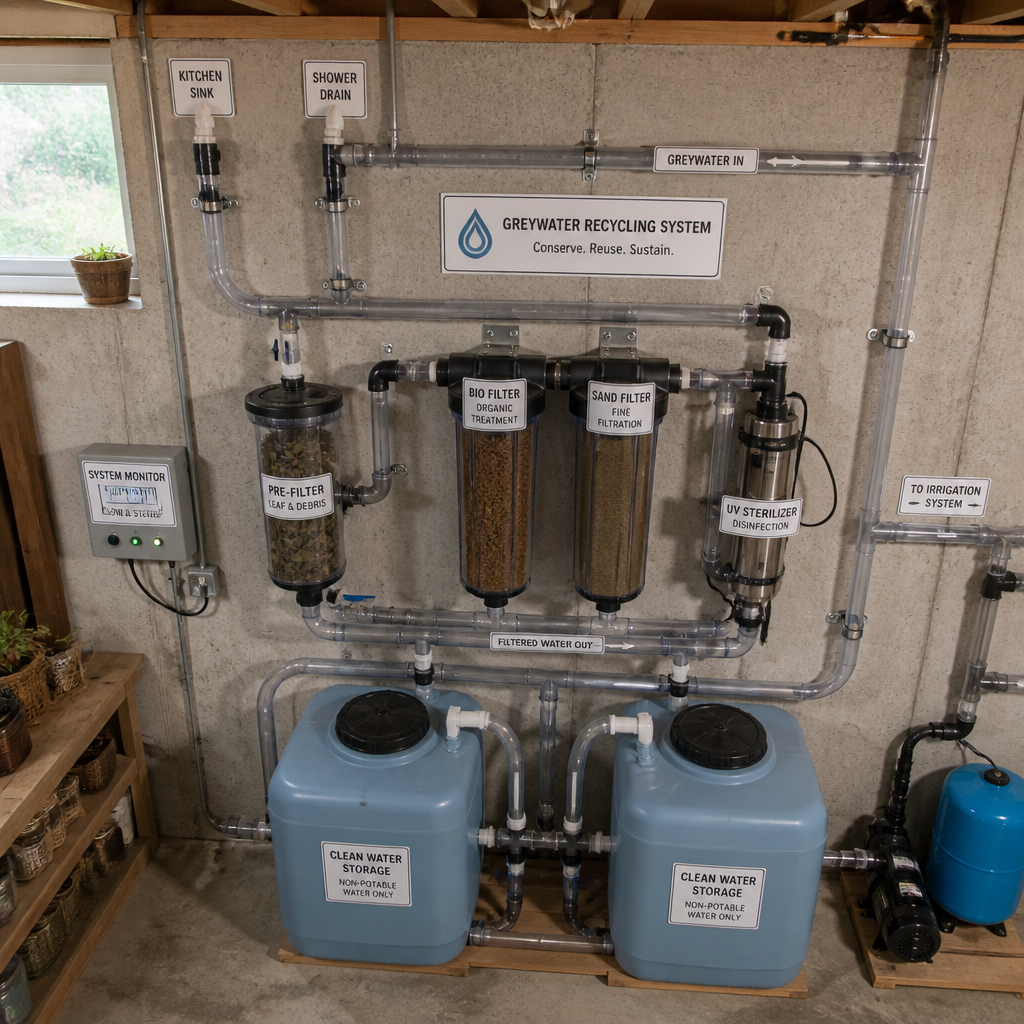
If your homestead draws water from a well, hauls it in, or depends on a rain catchment system, every litre you pour down the drain is a resource you paid for twice. Greywater recycling on the homestead closes that loop. Sink, shower, and laundry water can be redirected to irrigate trees, feed constructed wetlands, or flush toilets year-round, cutting your freshwater demand significantly while extending the life of your septic system. The systems are not complicated. What gets in the way is usually uncertainty about regulations, cold-climate performance, and where to start.
Table of Contents
- Quick Takeaways
- What Is Greywater and What Is Not
- Regulations for Off-Grid Greywater in Canada
- The Three System Types That Actually Work
- Making Greywater Work Year-Round in Cold Climates
- Choosing the Right Soaps and Detergents
- System Comparison: Which Setup Fits Your Homestead
- Frequently Asked Questions
- References
Quick Takeaways
| Key Insight | Explanation |
|---|---|
| Greywater is not blackwater | Water from sinks, showers, and laundry contains no fecal matter and is safe to reuse for sub-surface irrigation and toilet flushing when handled correctly. |
| Regulations vary by Canadian province | Ontario’s building code permits greywater for sub-surface irrigation and toilet supply if treated to code standards. Always check your municipality before building. |
| Laundry-to-landscape is the easiest entry point | Your washing machine already has a pump. Redirecting the discharge hose to an outdoor mulch basin requires no plumbing changes and costs under $100 in materials. |
| Bury pipes below frost line for winter use | In most of Canada, outdoor greywater pipes must be buried at least 1.2 to 1.5 metres deep, or the system must be drainable before freeze-up. |
| Sodium and boron are the main soil killers | Many “eco” detergents still contain high-sodium or boron compounds that degrade soil structure. Only use detergents specifically formulated as greywater-safe. |
| Size your system for winter volume, not summer | Hot showers and more indoor time in winter increase greywater output. A system built around summer averages will be overwhelmed from November to March. |
| Mulch basins continue to function below the frost line | Even when the surface freezes, soil below acts as insulation. Deeply buried outlets keep biological activity alive through a Canadian winter. |
What Is Greywater and What Is Not
Greywater is any household wastewater that has not come into contact with toilet waste. That includes water from bathroom sinks, showers, bathtubs, and washing machines. It does not include kitchen sink water in most jurisdictions, and it never includes toilet waste, which is classified as blackwater.
The distinction matters because greywater carries far fewer pathogens than blackwater and does not require the same level of treatment before beneficial reuse. That said, greywater is not clean water. It contains soap residue, skin cells, hair, and trace amounts of personal care products. Treat it as a resource that needs managed delivery, not as something you can spray freely around your property.
Kitchen sink water sits in a grey area, literally. It contains food particles, grease, and organic matter that will clog most passive systems quickly. On a homestead, the practical answer is to keep kitchen sink water out of your greywater system unless you have a robust biofilter designed to handle it. Route kitchen sink drainage to your septic or composting system instead.
Pro tip: Install a simple three-way diverter valve between your greywater source and your system. This lets you route water to the sewer or septic on days when you use harsh cleaning chemicals, bleach, or when someone in the household is sick, without any rerouting of pipes.


Regulations for Off-Grid Greywater in Canada
This is the section most homesteaders skip, and it is the one that causes the most problems later. Off-grid does not mean unregulated. Canadian provinces each set their own rules, and municipalities add another layer on top of that.
What Ontario’s Building Code Actually Says
Ontario’s building code permits treated greywater to be used for toilet flushing, urinals, sub-surface irrigation, and trap priming, provided it is free of solids and treated to meet the relevant article of the code. That is a workable standard for most homestead systems. The key phrase is “free of solids and treated.” A mulch basin or sand filter upstream of your point of use is typically enough to satisfy that requirement, but get confirmation from your local building department before you build.
The Broader Canadian Picture
Most provinces allow greywater reuse in rural and off-grid contexts when proper drainage is used, but the specifics differ. British Columbia, Alberta, and Quebec all have their own codes, and some require permits even for simple laundry-to-landscape systems. The safest approach is to call your regional health authority or municipal building department and ask directly about sub-surface greywater disposal on private rural land.
Canadian environmental standards are strict, and improper waste disposal can result in significant fines. Do not assume that because you are far from town, nobody is checking. Greywater systems that cause surface ponding, runoff into waterways, or odour complaints are the ones that attract enforcement attention.
The simplest rule for greywater on a Canadian homestead: keep it below ground, keep it moving, and never let it surface or reach a watercourse. Systems that follow this principle rarely run into regulatory trouble.
Pro tip: Document your system with a simple hand-drawn diagram showing pipe routes, depths, outlet locations, and the mulch basin or biofilter design. Keep it in a binder with your well records and septic paperwork. If a building inspector ever visits, having a clear record of your system shows intent and care, which goes a long way.
The Three System Types That Actually Work
There are dozens of greywater system designs in circulation, but for a homestead context most of them reduce to three workable approaches. The right one depends on your site, your water sources, and how much you want to build.
Laundry-to-Landscape
This is where almost every homesteader should start. Your washing machine already contains a pump powerful enough to push water uphill and across reasonable distances. You redirect the discharge hose through a three-way valve to an outdoor mulch basin or directly to the root zone of established trees and shrubs.
A single laundry cycle produces roughly 150 litres of water, which is a meaningful amount for any garden. The installation requires no changes to your home’s plumbing system, no permits in many jurisdictions (verify locally), and materials that cost well under a few hundred dollars. The limitations are real: you cannot use this system for food crops, and it is seasonal on most Canadian properties without insulation work.
Branched Drain System
A branched drain system collects water from multiple sources, typically showers, bathtubs, and bathroom sinks, and uses gravity to distribute it through a series of splitters to multiple mulch basins. No pump is required. The tradeoff is precision: every run of pipe must maintain a consistent slope of roughly 2% to keep water moving and prevent stagnation. Installation is more involved than laundry-to-landscape, but the result is a system that handles a much larger volume of water from multiple household sources.
This is the system to build if your bathroom is on an upper floor with a downhill landscape. If your land is flat or your bathroom is at grade, you will need either a pump or a different approach.
Constructed Wetland or Biofilter
A constructed wetland uses layers of gravel, sand, and aquatic or semi-aquatic plants to biologically filter greywater before it disperses into the soil or is reused for irrigation. It is the most effective system for treating large volumes of water and for properties that want to reuse greywater for toilet flushing year-round.
The system requires more space and upfront investment than the other two options, but it is also the most resilient. Constructed wetlands buried against the south side of a building and insulated at the surface can remain biologically active through most Canadian winters. The wetland itself becomes a productive part of the homestead, growing medicinal herbs, sedges, or other useful plants.

Making Greywater Work Year-Round in Cold Climates
Cold climate performance is where most greywater information falls apart. Advice written for California or Arizona does not translate to an Ontario or BC winter. Here is what actually applies to Canadian conditions.
Pipe Burial Depth
Any outdoor greywater pipe must be buried below the local frost line to avoid freezing and bursting. In most parts of Canada, that means burial depths of 1.2 to 1.5 metres or more. In the far north, even deeper. If you cannot bury pipes to that depth due to bedrock or other constraints, design a drain-back system that empties all outdoor pipes back into the building when flow stops. Trapped water in above-ground pipes will freeze, and you will be rerouting to the septic all winter.
Mulch Basins in Winter
Mulch basins freeze at the surface but continue to function below the frost line. The soil acts as insulation, and biological activity continues in the warmer layers beneath. A mulch basin must be designed with a minimum 2% slope away from the water entry point, protected from surface runoff, and deep enough that its lower layers remain above freezing even when the top surface is frozen solid.
The key practical step is sizing your mulch basins generously. A basin that handles summer volume adequately will likely be overwhelmed in winter when shower frequency and laundry load increase. Build for your peak winter output, not your summer average.
The Greenhouse Option
If your homestead includes an attached or connected greenhouse, redirecting greywater into a biofilter inside the greenhouse is one of the cleanest cold-climate solutions. The heated space prevents freezing, the plants benefit from the nutrients, and the biofilter treats the water before it reaches the soil. An insulated woodchip biofilter that captures grease and solids before the water reaches plant roots handles most of what comes off a homestead sink.
Seasonal Shutdown Procedure
For systems that cannot be fully winterized, build a clean seasonal shutdown procedure into your design from the start. Install accessible cleanouts, ensure all outdoor lines drain by gravity, and mark the diverter valve clearly so any household member can switch back to septic before hard frost arrives. A system that shuts down cleanly for winter and restarts in spring is far more practical than a half-frozen system that causes problems all season.
Choosing the Right Soaps and Detergents
The products you use in your household directly determine whether your greywater helps or harms your land. This point is consistently underestimated by homesteaders setting up their first system.
Products labelled “biodegradable” or “natural” are not automatically greywater-safe. Many of them still contain compounds that damage soil structure or harm plants. The specific ingredients to avoid include chlorine or bleach, sodium perborate, boron, borax, petroleum distillates, and “whiteners” or “enzymatic” components. Sodium is the most common problem: high sodium levels raise soil alkalinity, degrade soil structure over time, and can build up to levels that limit plant growth.
The practical standard is to use detergents and soaps specifically formulated to be greywater-compatible. These products use potassium rather than sodium as a base, use plant-derived surfactants, and are designed to biodegrade into compounds that benefit rather than damage soil. Products containing tea tree oil, aloe vera, and coconut oil are generally gentle on plants and soil structure.
On the homestead, this also means reconsidering your cleaning products more broadly. Drain cleaners, bleach-based cleaners, and conventional antibacterial soaps should never enter your greywater system. Keep a container of an alternative disinfectant on hand for cleaning days, and route drain water from those activities to the septic instead.
Pro tip: Keep a simple laminated list of approved and banned products on your laundry room wall and near the kitchen sink. When guests are staying or when you buy a new product, the reminder is there. One load of wash with the wrong detergent is not a disaster. A winter of it is.
System Comparison: Which Setup Fits Your Homestead
| System Type | Best Conditions | Cold Climate Performance |
|---|---|---|
| Laundry-to-Landscape | Small homesteads, established trees and shrubs downhill from laundry room, low budget, first-time installers. No extra pump needed. Easiest permit situation in most provinces. | Seasonal only without insulated buried lines. Drain outdoor lines before hard frost. Can continue year-round if discharge is routed into a heated space or deeply buried mulch basin. |
| Branched Drain | Properties with upper-floor bathrooms and sloped landscape. Handles shower, tub, and sink water simultaneously. Gravity-fed with no electrical requirement. | Requires pipes buried below frost line. Mulch basins function sub-surface through winter. Design for peak winter water volume. Include bypass to septic for extreme cold events. |
| Constructed Wetland or Biofilter | Larger households with high daily water output. Properties wanting toilet-flush reuse year-round. Homesteads with greenhouse or south-facing structure for insulated indoor placement. | Best year-round option when built against a south-facing structure or inside a greenhouse. Remains biologically active below surface even when top layer freezes. Highest upfront cost but lowest maintenance once established. |
In practice, the progression on most homesteads goes from laundry-to-landscape in year one, to a branched drain covering the bathroom in year two or three, to a constructed wetland or biofilter if water volumes and ambitions grow. You do not need to build the whole system at once. Each stage is useful on its own.
Frequently Asked Questions
Can I use greywater on my vegetable garden?
Not directly and not above-ground. Greywater should not be sprayed on or allowed to contact edible parts of food plants. Sub-surface irrigation to the root zone of fruit trees and established shrubs is generally accepted practice, but avoid any direct contact with leaves, stems, or fruits you will eat. Most greywater codes and practical guidance treat ornamentals, fruit trees, and non-edible plants as the appropriate targets for greywater irrigation.
Is greywater recycling legal in Canada?
Generally yes, with conditions that vary by province and municipality. Ontario, British Columbia, and most other provinces permit sub-surface greywater disposal and in some cases toilet-flush reuse when the water meets basic treatment standards. The legal risk comes from surface ponding, discharge into waterways, or systems built without any permits in areas that require them. Contact your regional health authority or municipal building office before building anything permanent.
How much water can I realistically save with a greywater system?
Estimates vary, but greywater reuse can reduce freshwater demand by a meaningful amount for a household that runs it consistently. A single laundry cycle produces roughly 150 litres of water. Showers contribute another significant daily volume. For a homestead that hauls water or depends entirely on a well, redirecting even laundry water alone can extend your water supply significantly through dry months. The exact savings depend entirely on your household’s usage patterns and which sources you connect to the system.
What is the biggest mistake people make with DIY greywater systems?
The most common mistake is building a system sized for summer water use without accounting for winter. In cold climates, greywater output increases in winter (longer, hotter showers, more indoor laundry) while the system’s capacity to disperse and treat water decreases. The second most common mistake is not installing a diverter valve, which means the moment someone uses bleach or gets sick, there is no easy way to bypass the system and protect the soil. Build the bypass in from day one.
How do I maintain a greywater system on the homestead?
Passive systems like laundry-to-landscape and branched drain systems need relatively little maintenance: clear the lint filter or hair strainer regularly, refresh the woodchips in your mulch basin annually, and inspect pipe connections each spring after frost. Constructed wetlands need periodic removal of excess plant growth and occasional flushing of the inlet zone if solids accumulate. The most important maintenance habit is using only greywater-compatible soaps and detergents consistently, because a single season of wrong products can degrade your soil’s receiving capacity.
Can a greywater system work during a Canadian winter without shutting down?
Yes, but it requires design choices made at installation time. Buried pipes below the frost line, deeply placed mulch basins with good insulating mulch cover, and a constructed wetland placed against a south-facing structure or inside a greenhouse can all function through Canadian winters. A system that was designed for warm-season use and then patched for winter usually fails. If you want year-round performance, plan for it from the beginning: size generously, bury deeply, and include a bypass for extreme cold events.
Have you set up a greywater system on your property? We would love to hear what worked, what surprised you, and how you handled your first winter with the system running.
References
- Greywater Action: Overview of greywater reuse systems, source types, and safe practices for landscape irrigation
- Greywater Action: Cold climate greywater systems including constructed wetlands and biofilter design
- InspectApedia: Greywater system freeze protection design for cold climates
- Harvesting Rainwater: Guide to greywater-compatible soaps and detergents and ingredients to avoid
- Homestead Projects: Step-by-step guide to building a basic greywater recycling system for landscape irrigation
Leave a Reply