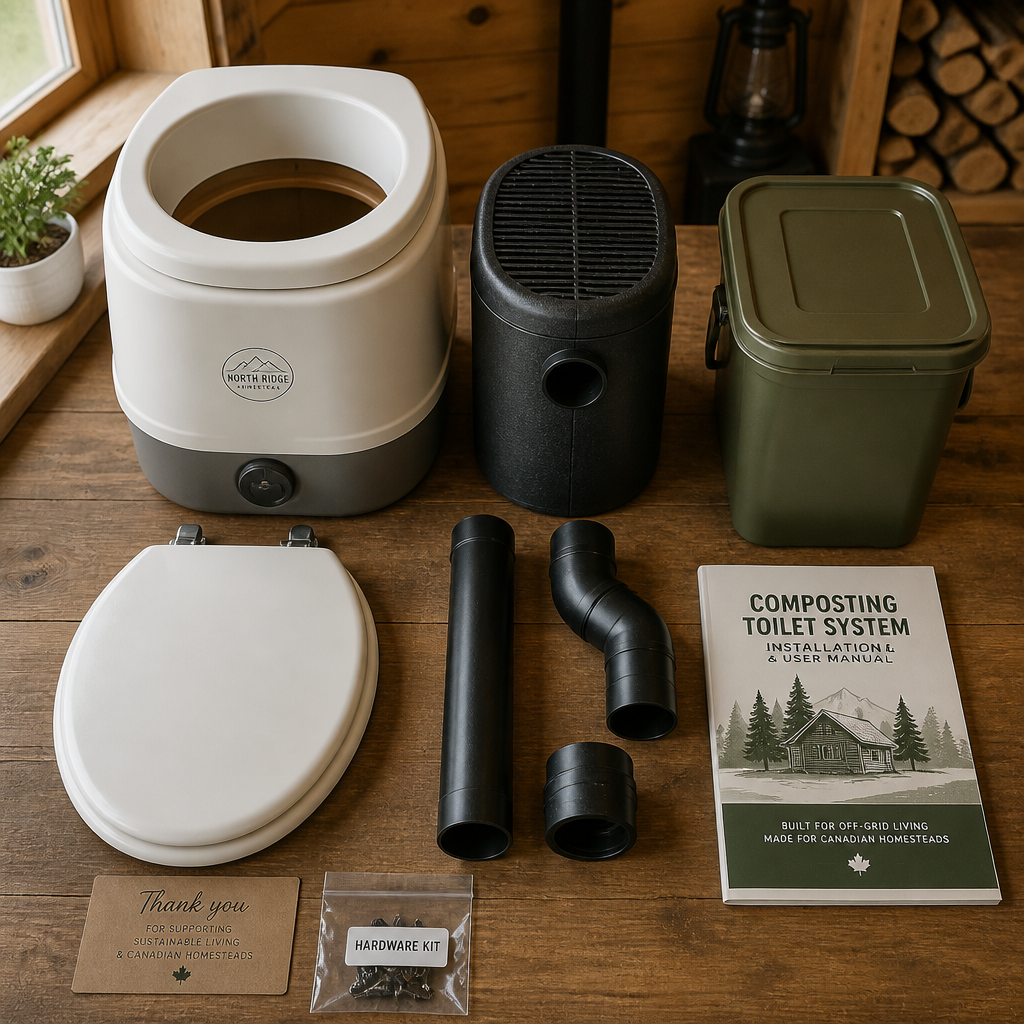
You have found the perfect remote property in Canada. The land is yours, the well is in, and the solar panels are on order. Then someone asks: “What about the toilet?” For many Canadian homesteaders and remote property owners, sanitation is the last thing planned and the first thing that causes serious headaches. A composting toilet off grid Canada setup is not simply a matter of buying a unit and bolting it down. Climate extremes, provincial regulations, greywater rules, and capacity demands all shape which system actually works on your land, long-term. This guide cuts through the marketing noise and gives you an honest breakdown of the best composting toilet systems for Canadian remote properties.
Table of Contents
- Why Composting Toilets Make Sense for Canadian Off-Grid Properties
- Canadian Off-Grid Regulations: What You Must Know Before You Buy
- The Cold-Climate Problem: Composting in Canadian Winters
- Best Composting Toilet Systems for Remote Canadian Properties
- System Comparison Table
- Greywater: The Missing Half of Off-Grid Sanitation
- Installation and Maintenance Realities
- Frequently Asked Questions
- References
Why Composting Toilets Make Sense for Canadian Off-Grid Properties
A conventional septic system on remote Canadian land can cost tens of thousands of dollars once you factor in soil testing, excavation, a licensed installer, and a system sized for your province’s loading requirements. On rocky or clay-heavy land, those costs climb further, and in many northern areas the frost depth makes installation impractical altogether.
Composting toilets sidestep the septic requirement by converting solid human waste into dry, stable material through aerobic decomposition. No water connection is needed for the toilet itself, which also means no frozen pipes leading to a tank buried in ground that might heave. For a remote Canadian cabin, seasonal retreat, or year-round homestead without road access, that independence has real value.
The composting process works by evaporating the liquid fraction of waste and then breaking down the remaining solids using heat, oxygen, and microbial activity. Done correctly, the end product is a dry, odour-minimal material that can often be used in non-edible garden applications, depending on your province’s guidelines.
Pro tip: Do not conflate “composting toilet” with “outhouse.” A properly maintained composting toilet system, installed in a heated or insulated space, produces no sewage odour inside the living area when the ventilation is working correctly. The biggest sources of odour complaints are undersized fans, improper bulking material ratios, and ignoring the liquid diversion system.


Canadian Off-Grid Regulations: What You Must Know Before You Buy
This is where most guides fail Canadian readers. Sanitation regulation in Canada is provincial, not federal, and the rules differ significantly between provinces. Buying a unit before checking your local requirements is how people end up with a system they cannot legally use or a permit they cannot obtain.
British Columbia
BC is the most clearly regulated province for composting toilet installations. In 2016, the BC Ministry of Health established composting toilets and greywater systems as a recognised sewerage system option under the Sewerage System Regulation (SSR). The province published the Manual of Composting Toilet and Greywater Practice as the standard reference document for planning, installation, and maintenance.
Under the SSR, any composting toilet system in BC must be installed by or under the supervision of an Authorized Person, either a Registered Onsite Wastewater Practitioner or a qualified professional. That person files documentation with the local health authority. If you are in the Comox Valley Regional District or most other regional districts in BC, this filing is mandatory regardless of whether your property is serviced or remote. Do not skip this step.
A critical point in BC: even with a composting toilet, greywater from your sinks, shower, and laundry must still go to an approved on-site greywater treatment and dispersal system. The composting toilet only addresses the toilet waste stream.
Ontario, Alberta, and Other Provinces
Ontario and Alberta do not have a single unified provincial standard equivalent to BC’s SSR manual. Requirements vary by municipality and regional health unit. In practice, this means you contact your local building department and health unit directly, describe your proposed system, and get written confirmation of what is permitted before purchase. Some rural Ontario and Alberta municipalities are accommodating; others require a full septic system regardless.
A common mistake is assuming that because a property is remote and unserviced, nobody will enforce sanitation rules. Building permit inspections, property sales, and insurance claims can all surface non-compliant sanitation arrangements at the worst possible moment.
The permit question is not about bureaucracy for its own sake. It is about knowing whether your end product can legally go into your soil, and whether your system will survive a municipal inspection when you eventually sell or refinance.
Pro tip: When contacting your local authority, ask specifically whether the composting toilet unit you are considering holds NSF/ANSI 41 certification or an equivalent provincial approval. Many Canadian health authorities use NSF 41 certification as their baseline standard for approving a composting toilet for permitted use. Units that lack this certification face much more friction during the permit process.
The Cold-Climate Problem: Composting in Canadian Winters
Aerobic composting is a biological process. Bacteria and other microorganisms do the work, and they are temperature-sensitive. Composting functions well above roughly 13 degrees Celsius. Below freezing, microbial activity slows dramatically or stops. This is the central challenge for any Canadian using a composting toilet in an unheated or minimally heated space.
The good news is that if your composting toilet is installed inside your heated living area, the winter temperature problem largely disappears. The bacteria are working in an environment that stays above freezing, and the composting process continues through January in Sudbury or Prince George just as it does in September.
The challenge arises in seasonal cabins left unheated for extended periods, or in outbuildings and bathroom additions that are poorly insulated. In those settings, the solids chamber can freeze solid. The material will not decompose while frozen, but a well-designed unit will not be permanently damaged by freezing either, as long as the liquid diversion is working properly and liquid is not allowed to accumulate and freeze in the chamber.
When you return to a frozen cabin in spring, allow the unit to thaw gradually in the heated interior before use. Do not add fresh material to a frozen chamber. Give it several days to return to temperature, then resume normal use and bulking material addition. The microbial community re-establishes itself once conditions warm.
Best Composting Toilet Systems for Remote Canadian Properties
The market has consolidated around a handful of systems that genuinely work for off-grid Canadian conditions. Here is an honest assessment of the most relevant options, based on real-world performance criteria for remote properties.
Nature’s Head Self-Contained Composting Toilet
The Nature’s Head is the most widely used self-contained composting toilet in the Canadian off-grid community, and for good reason. It is robustly built, separates liquids and solids effectively through a urine diverter, and requires no water or chemicals. The solids chamber holds approximately 60 to 80 uses before it needs to be emptied, which translates to roughly one month for two full-time users.
The unit runs a small fan for ventilation, drawing only a modest amount of power, which is well within the capacity of a basic solar setup. The fan vents odour outside through a small-diameter pipe, and in practice the toilet is odour-free inside when the vent is correctly installed. The unit works without electricity if needed, though the passive ventilation is less effective without the fan running.
For cold climates, Nature’s Head performs well when kept in a heated interior space. Users across northern Canada and the northern United States report no functional issues through winter when the toilet is installed in a heated room. The absence of any water in the system means there is nothing to freeze in the unit itself.
Separett Villa
The Separett Villa is a urine-diverting waterless toilet that offers a different approach to composting. Rather than composting waste in a chamber directly below the seat, the Separett separates urine and diverts it to a greywater system or external container, while solids drop into a biodegradable liner bag inside the unit. The bag is removed and placed in a compost bin or disposal container when full, rather than composting in place.
This approach offers effectively unlimited capacity in terms of the toilet unit itself, since you are simply swapping bags rather than waiting for a chamber to finish composting. The Separett Villa runs on 12V DC power, making it compatible with off-grid solar systems, and its strong fan can handle vent runs up to about 6 metres with up to three 90-degree elbows.
For remote Canadian properties where regular emptying of a solids chamber is inconvenient, the bag-based system can be more practical. The trade-off is that you need a plan for the bags. In BC and most provinces, the contents must be managed according to local guidelines, and you need adequate outdoor space for a secondary compost area.
Sun-Mar Self-Contained Units
Sun-Mar is a Canadian-founded composting toilet manufacturer with a long track record in the cottage and cabin market. Their self-contained units integrate the composting chamber directly into the toilet unit, and the company makes both electric and non-electric models. The non-electric models are fully off-grid compatible.
Sun-Mar units use a drum-based composting system with a rotating drum that mixes and aerates the compost when turned. This speeds up decomposition and reduces the time material sits in the chamber. Their self-contained units have historically been priced in the range of roughly $1,700 to $1,900 CAD for basic models, with higher-capacity central systems considerably more expensive.
The central system design, where the toilet sits at floor level and waste drops to a composting unit in the basement or crawl space, is worth considering for full-time Canadian homesteads. It separates the composting function from the living area entirely and allows for larger chamber capacity suited to year-round family use.

System Comparison Table
Each of these three systems suits a different type of Canadian off-grid property owner. The table below compares them across the criteria that matter most in remote Canadian conditions.
| Feature | Nature’s Head | Separett Villa | Sun-Mar Non-Electric |
|---|---|---|---|
| Power requirement | Small 12V fan (optional for passive use) | 12V DC fan (required for odour control) | None (non-electric model) |
| Composting method | In-unit chamber with peat moss or coco coir | Bag-based, secondary compost bin needed | Rotating drum in integrated chamber |
| Capacity (2 full-time users) | Approx. 1 month before emptying | Unlimited (bag swap as needed) | Varies by model, generally 1-3 months |
| Cold-climate suitability | Excellent when in heated interior | Excellent when in heated interior | Good; drum helps aeration in marginal temps |
| Installation complexity | Low, self-contained, portable | Low to moderate, vent run required | Moderate, drum mechanism requires level base |
| Best suited for | Seasonal cabins, van, boat, small off-grid home | Year-round remote homes, larger households | Full-time homesteads, no power available |
| NSF 41 certified | Yes | Check current certification status with supplier | Yes (most models) |
Greywater: The Missing Half of Off-Grid Sanitation
Installing a composting toilet solves the toilet waste stream. It does not solve greywater from your sink, shower, or laundry. Many first-time off-grid property owners are surprised to discover that provinces like BC explicitly require a separate, approved greywater treatment and dispersal system even when a composting toilet is in place.
Greywater from a kitchen sink contains fats, food particles, and soaps. Shower and laundry water contains soaps, personal care products, and pathogens. This water cannot simply be discharged to the ground surface in most provinces without treatment. Even in provinces with looser rural rules, untreated greywater discharge near water bodies or wells is prohibited under federal environmental protection frameworks.
Practical greywater options for remote Canadian properties include constructed wetlands, mulch basin systems, sand filter systems, and purpose-designed greywater treatment units. The right choice depends on your soil type, water volume, and local climate. A property that gets 8 months of frost-free conditions manages greywater very differently from one that gets 4.
The takeaway is this: budget for greywater management separately from your composting toilet purchase, and address both in your permit application at the same time. Trying to add greywater management as an afterthought after your composting toilet is installed is more expensive and more difficult to get approved.
Installation and Maintenance Realities
A composting toilet is not zero-maintenance. It is lower-maintenance than a septic system, but it requires consistent attention to function well. Here is what the maintenance actually looks like in practice.
Bulking Material
For in-unit composting systems like the Nature’s Head or Sun-Mar, every solid deposit needs a covering of bulking material. Peat moss and coconut coir are the standard choices. Peat moss is widely available across Canada and absorbs moisture effectively, which is critical for the composting process. After each use, a small scoop of bulking material is added to the solids chamber. This is not optional. Skipping it leads to odour problems and wet, anaerobic conditions that slow decomposition.
Liquid Management
Urine diversion is the most important functional feature of any composting toilet. When liquid and solid waste mix, the result is anaerobic, smelly, and difficult to compost properly. All three systems reviewed above separate liquids and solids. The liquid fraction must go somewhere: a dedicated container that is emptied regularly, a greywater system with appropriate dilution, or in some rural situations, a well-drained area of the property away from wells and water features.
Chamber Emptying and Compost Curing
When the solids chamber is full, the material is not immediately finished compost. It is partially decomposed organic matter that needs additional curing time, typically several months in aerobic conditions, before it is stable enough for garden use. Many off-grid homesteaders maintain a secondary outdoor compost bin where material from the toilet chamber is transferred and left to cure through at least one full season before any use on the land.
Pro tip: Keep a dedicated compost curing bin away from your primary vegetable garden and clearly labelled. Material from the composting toilet chamber should cure for a minimum of one full year before any contact with edible crops, and even then, applying it only to non-edible plantings is the safer and more provincially defensible approach.
Frequently Asked Questions
Is a composting toilet legal in Canada?
Yes, composting toilets are legal across Canada, but the regulatory framework varies by province and municipality. British Columbia has the clearest provincial standard through its Sewerage System Regulation and the Manual of Composting Toilet and Greywater Practice. Other provinces handle approvals at the municipal or regional level. Always check with your local building department and regional health authority before purchasing a system.
Do composting toilets work in Canadian winters?
They work well when installed inside a heated living space. Composting is a biological process that requires temperatures above freezing to function. A composting toilet inside a cabin that is heated through winter will operate normally year-round. In unheated seasonal structures, microbial activity pauses during cold periods but typically resumes when temperatures rise. Proper liquid diversion prevents freeze damage to the unit itself.
How often does a composting toilet need to be emptied?
This depends on the system and how many people use it. For a self-contained unit like the Nature’s Head with two full-time users, the solids chamber typically needs emptying roughly once a month. Bag-based systems like the Separett work on a swap-as-needed basis, with bags changed more frequently but with less bulk per change. Sun-Mar drum systems vary by model capacity. Liquid containers or diversion lines require more frequent attention than solids chambers.
What do I do with the composted material in Canada?
The options in Canada are off-site disposal at an approved facility, on-site burial in a designated area, or on-site surface application after adequate curing, depending on your province. BC’s composting toilet manual specifically outlines these three pathways. In most provinces, applying incompletely processed toilet waste to vegetable gardens is not permitted, and applying it near water bodies or wells is prohibited regardless of province. Fully cured material applied to non-edible plantings or trees is the most widely defensible approach.
Do I still need a greywater system if I install a composting toilet?
Yes. A composting toilet addresses toilet waste only. Wastewater from sinks, showers, and laundry, collectively called greywater, requires a separate treatment and dispersal system in most Canadian provinces. British Columbia makes this explicit in its regulations. Even in provinces with less formal requirements, discharging untreated greywater to the surface or into natural water bodies is prohibited under environmental protection legislation. Budget and plan for greywater management as a companion system to your composting toilet.
Which composting toilet is best for a remote Canadian property without reliable electricity?
The Sun-Mar non-electric models are the clearest choice when no power is available at all. Nature’s Head operates on a very small fan but can function passively if needed, though ventilation is less effective without the fan. Separett’s Villa requires a 12V fan for adequate odour control and is not recommended for fully power-free installations. If you have a small solar setup, even a modest panel and battery can run the Nature’s Head fan indefinitely, making it viable for almost any remote Canadian setup.
What is the best composting toilet for a full-time Canadian homestead with a family?
For a year-round family homestead, a central composting system from Sun-Mar or a comparable manufacturer is worth the additional installation complexity. Central systems separate the composting chamber from the bathroom entirely, placing it in a basement or utility space. They offer higher capacity than self-contained units and are better suited to daily full-time family use. Pair it with a robust greywater system and get everything permitted through your local authority at the planning stage, before you break ground.
Have you installed a composting toilet on your Canadian property? Share what system you chose and what surprised you most about the process in the comments below.
References
- BC composting toilet regulations and the Sewerage System Regulation overview from the Comox Valley Regional District
- BC Ministry of Health: Manual of Composting Toilet and Greywater Practice (official provincial standard)
- Overview of composting toilet types and Canadian off-grid sanitation alternatives from Green Building Canada
- Comparison of off-grid toilet systems for Canadian cabins and remote properties
- Practical off-grid toilet options including cold-climate considerations for Canadian homesteaders
Leave a Reply