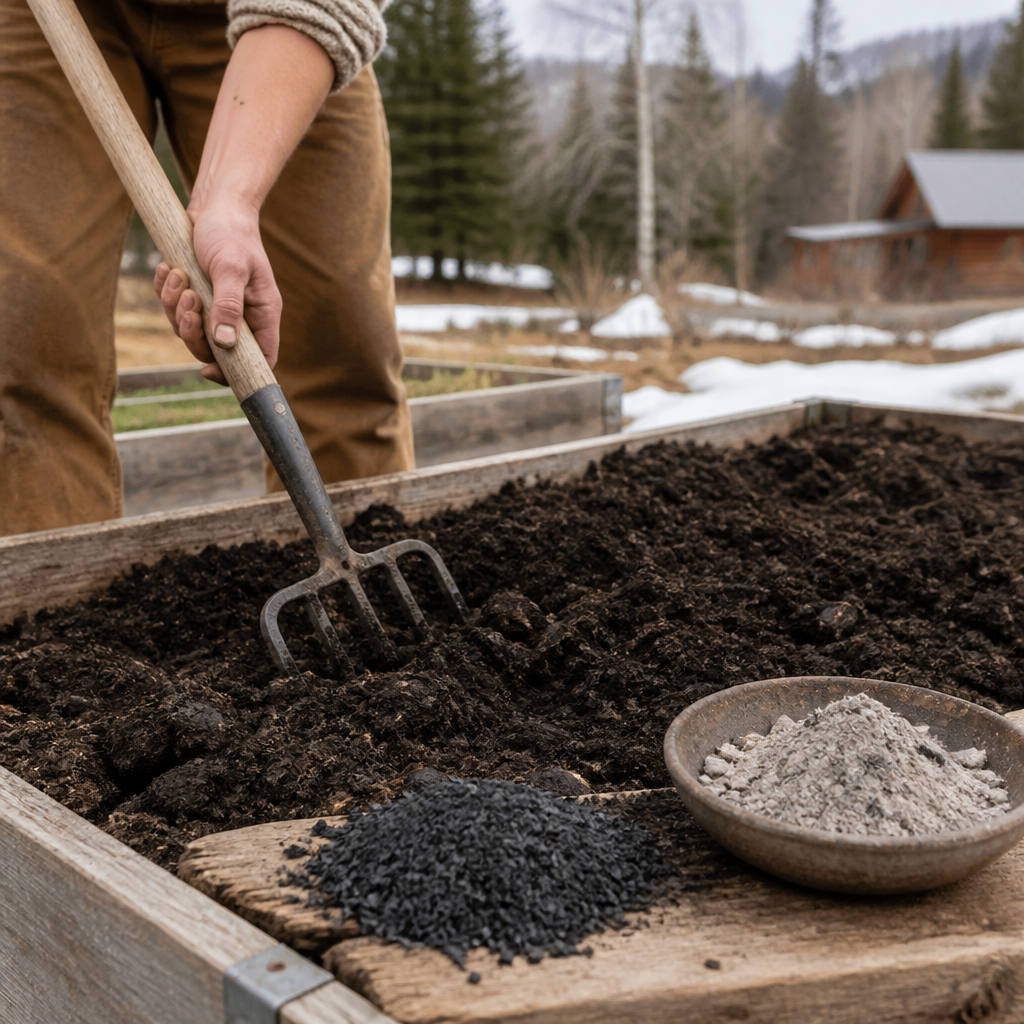
Every homestead garden hits the same wall eventually. The beds grew well for a few seasons, then yields slump, the topsoil crusts over, and the compost you haul in no longer keeps up. Soil amendments for a homestead garden are the usual answer, but three products come up constantly in off-grid circles: biochar, wood ash, and kelp meal. Each changes soil in a different way, and treating them as interchangeable is the fastest route to wasted money and stunted plants. Here is how each one behaves, where it fits a remote property in Canada, and what to skip.
Table of Contents
- Quick Takeaways
- What Soil Amendments Actually Do
- Biochar in the Off-Grid Garden: Porous Carbon That Stays Put
- Wood Ash in the Garden: Useful, Dangerous, and Specific
- Kelp Meal for Slow Nutrition and Soil Life
- Comparison: Biochar, Wood Ash, and Kelp Meal Side by Side
- Common Mistakes With Soil Amendments
- Building Your Amendment Plan for the Season
- Frequently Asked Questions
- References
Quick Takeaways
| Key Insight | Explanation |
|---|---|
| Biochar is a structure builder, not a fertilizer | Its porous carbon holds air, water, and microbes. Expect changes in how soil drains and holds moisture over several seasons, not a green flush next week. |
| Charge biochar before it goes in the bed | Soak or mix it in finished compost for several weeks so its pores fill with nutrients instead of pulling them away from your plants. |
| Test pH before you add wood ash | Ash pushes pH upward quickly. On naturally alkaline prairie soil, one heavy application can cause problems for years. |
| Use ash only from clean, untreated wood | Ash from painted, glued, or treated lumber, or from burned garbage, carries contaminants you do not want near food. |
| Kelp meal feeds slowly | It releases minerals and supports organic matter over months, so apply it in fall or early spring rather than in the middle of a crop. |
| Use liquid kelp for a quick top-up | Liquid kelp acts faster but adds little bulk. Treat it as a supplement to a solid base, not a replacement for one. |
| Match the amendment to your test result | Stacking all three at once makes it impossible to know what worked. Pick the one that addresses a measured problem. |
What Soil Amendments Actually Do
Soil amendments do three different jobs, and most disappointments come from asking one product to do all three. Some change physical structure, such as how water drains and how easily roots push through. Others correct chemistry, mainly pH, and some supply nutrients or feed the soil food web. Biochar mostly works on structure, wood ash on chemistry, and kelp meal on slow nutrition and organic matter.

Reading a Soil Test Before You Buy Anything
Nothing replaces knowing what your soil actually contains. Most people assume they know their soil from how it looks and feels, but colour and texture tell you very little about pH or nutrient levels. A basic lab test gives you pH, organic matter, and the main nutrients, which is the information you need before spending money. Off-grid growers sometimes skip testing because the nearest lab is a long drive, but mail-in kits solve that problem.
Canadian soils vary a lot. Much of the Canadian Shield and large parts of eastern Canada tend to have acidic soils, while many Prairie soils are naturally alkaline. Those two situations call for opposite decisions about wood ash, which is why generic amendment advice causes damage when it is applied without a test.
An amendment that fixes one bed can quietly damage the next, so the soil test is the only honest starting point.
Biochar in the Off-Grid Garden: Porous Carbon That Stays Put
What Biochar Is and Why Its Pores Matter
Biochar is organic material heated in a low-oxygen environment, a process called pyrolysis. The Royal Horticultural Society describes the heating range as 300 to 1000°C, and what remains is a solid residue that is at least 80 percent elemental carbon. Almost any organic feedstock can be used, from soft plant tissue and woody material to manure, and the feedstock changes the final product.
The reason biochar matters is its structure. Wood-based biochar keeps much of the open channel network of the original wood, so a fragment under a microscope looks like a sponge full of empty chambers. Those chambers can hold air, water, and habitat for soil organisms. The Storey guidance on garden biochar makes the same point: the material is not nutrient-rich in its own right, but finely ground pieces have far more surface area, and that surface area is what does the work.
Pro tip: Screen out the big chunks and wet the fine dust before you spread it. Dry biochar dust is unpleasant to breathe and blows away from the bed you were trying to improve.
Making or Buying Biochar Safely
Know your feedstock before anything else. Clean, untreated hardwood gives the most predictable results. Avoid anything painted, pressure-treated, glued with particleboard resins, or made from plastics, because those contaminants do not disappear in the kiln.
Whether you make it or buy it, ask what went in and what temperature it was made at. Products sold as biochar vary widely, so a bag of grill charcoal fines is not the same material as a carefully produced soil biochar. If you make your own in a drum or small kiln, keep the work outdoors, away from dry grass, and cool the char fully before handling. Good biochar is dry and cool, and it smells mostly of smoke.
Charging Biochar Before It Enters the Bed
Raw biochar can be hungry. Because its pores are empty, it can absorb nutrients from the soil around it, which can briefly leave your plants short. The fix is to charge it first. Mix it into finished compost, soak it in compost tea, or blend it with manure, then let it sit for several weeks before it goes into the bed.
Once charged, work it into the top layer of soil rather than leaving it in a heap. Treat biochar as a long-term structural investment, applied and reassessed over years rather than dumped in once. A Canadian fall is the easiest time to start: the material charges through winter in a covered pile and is ready for spring planting.
Wood Ash in the Garden: Useful, Dangerous, and Specific
Why Ash Raises pH and Where That Helps
Wood ash is the mineral residue left after wood burns. It contains calcium, potassium, and small amounts of other micronutrients, and it is strongly alkaline. That alkalinity is the reason gardeners use it: on acidic soil, a light application can raise pH toward a range where many vegetables grow more comfortably. It contributes little nitrogen, because nitrogen escapes as gas during burning, so ash is not a fertilizer to rely on for leafy growth.
Ash suits the acidic soils common across much of eastern Canada and the Shield, where a test shows low pH and beds have needed lime. For homesteaders who already burn wood, ash can be a sensible, cheap liming source on those sites. The point is the test, not the habit of tossing ash on everything.
Which Ash Is Safe to Spread
Only spread ash from clean, untreated wood. Ash from painted, stained, or pressure-treated lumber, from plywood or particleboard, or from anything burned with plastic or household waste has no place in a food garden. Coal ash is a different material with a different risk profile, and it should stay out of vegetable beds. If you are not sure what was burned, keep it out of the garden.
Store ash dry in a closed container until you spread it. Sieve out unburned chunks and charcoal, which can go into the biochar pile instead. Spread a thin, even dusting, then work it into the top few centimetres of soil. Wear a dust mask and eye protection, because wood ash is caustic.
Pro tip: Keep a labelled, lidded bucket for ash and fill it from one fuel source only. Mixing sources makes it impossible to know what you are adding to the beds.
Plants That Dislike Ash
Ash suits some crops and punishes others. Blueberries, potatoes, rhododendrons, and azaleas all prefer acidic conditions, and pushing their soil toward alkaline can lead to poor growth or, in potatoes, a higher risk of common scab. Keep ash away from those beds. Reserve it for crops that tolerate near-neutral soil, and only once your test confirms the need.
Kelp Meal for Slow Nutrition and Soil Life
Kelp Meal Versus Liquid Kelp
Kelp meal is dried, ground seaweed. It releases its contents slowly as soil microbes break it down, which makes it a long-term base rather than a quick feed. Its nutrient numbers are modest, with low nitrogen and moderate potassium, so think of it as a supplement that adds trace minerals and organic matter. Some growers credit seaweed with improving stress tolerance, but the evidence on that is mixed, so do not buy it on that promise alone.
Liquid kelp is a different product for a different job. It acts faster and suits active growth, when a plant needs a visible boost. The trade-off is that it adds little bulk to the soil. Many off-grid growers use meal to build the base and liquid for mid-season top-ups, and that split makes more sense than choosing one or the other.

Timing Kelp Meal in a Cold-Climate Season
Because kelp meal works slowly, timing matters more than rate. Spread it in fall on beds that will sit over winter, and let freeze-thaw cycles and winter microbial activity start breaking it down. Early spring is the second-best window, worked into the top few centimetres a few weeks before planting.
Avoid spreading it on frozen or waterlogged ground, where it can wash off and waste the material. Choose a source that documents how the seaweed was harvested, because sustainable harvesting matters for coastal ecosystems. Kelp meal is a low-risk first purchase since it is hard to overdo in the way ash or fresh manure can be.
Comparison: Biochar, Wood Ash, and Kelp Meal Side by Side
The three amendments do different jobs, and the table below puts their main effects next to each other. Use it as a quick filter before you read the detail above. Each row describes the typical effect, not a guaranteed result on your land.
| Amendment | Primary Effect in Soil | Where It Fits Best on a Homestead |
|---|---|---|
| Biochar | Improves structure, aeration, and habitat for soil organisms over several seasons | Long-term beds, sandy or compacted soil, and charging in a compost pile over winter |
| Wood ash | Raises pH quickly and adds calcium and potassium with little nitrogen | Acidic soil confirmed by a test, and beds for crops that tolerate near-neutral pH |
| Kelp meal | Releases trace minerals and supports organic matter slowly | A low-risk base for mixed beds, applied in fall or early spring |
For most off-grid gardens, the sequence is simple. Test first, build organic matter with compost, add biochar for structure and kelp meal for trace minerals, and use ash only where the pH data says it is needed. Ash is the amendment most likely to cause harm through misuse, so it deserves the most caution.
Common Mistakes With Soil Amendments
Applying Ash to Acid-Loving Crops
This is the most common and costly error. A gardener sees a bucket of ash, assumes it is free fertilizer, and spreads it over the whole garden. Blueberry bushes and potatoes then struggle, and the cause is hard to spot because the ash is invisible once it is worked in.
The fix is a simple map. Note which beds received ash, which did not, and which got it in previous years. Then retest the soil on a regular schedule rather than assuming the last application is still doing what you think it is doing.
Expecting Biochar to Feed Plants Right Away
Biochar is not a quick fix. Growers who add it raw and then see yellowing leaves often blame the product, when the real issue is nutrient tie-up in the pores before the biochar was charged. Charge it first, then give the bed a season or two before judging the result.
Stacking Amendments Without a Test
Adding biochar, ash, kelp meal, and a bagged fertilizer in the same spring makes it impossible to tell what changed. When yields improve or fall, you learn nothing useful. Change one variable per bed per season where you can, and write it down.
Building Your Amendment Plan for the Season
A workable plan starts with a soil test in early fall, while there is still time to act on the results. The test sets the pH target and shows whether organic matter is low. From there, the plan falls into three tracks: a structure track for biochar, a pH track for ash if the test calls for it, and a nutrition track for kelp meal and compost.

For an off-grid garden in Canada, October is a practical month to act. Charge biochar in covered compost over the winter, spread kelp meal on beds that will sit, and apply ash only after the test confirms it. Spring is for planting, not for guessing.
Keep the plan on paper or in a simple spreadsheet. Record the bed, the date, the amendment, the rate, and the test result it responded to. Over three or four seasons, those notes will tell you more about your land than any general guide, including this one.
Pro tip: Label each bed with what you added and when, on a stake or in your notebook. Three seasons later, nobody remembers which bed got the ash.
Frequently Asked Questions
Can I add biochar straight from the bag?
You can, but you should charge it first. Raw biochar has empty pores that can absorb nutrients from the soil around it, so mix it into finished compost for several weeks before it goes into the bed.
How often should I add wood ash?
Add it only when a current soil test shows low pH, and keep each application light. Retest the soil before the next application, because the test is the only reliable guide to how much your beds can take.
Is kelp meal worth buying for a small Canadian garden?
For many small gardens it is a low-risk choice. It adds trace minerals and supports organic matter over time, though it is not a substitute for compost or a soil test.
Can I mix wood ash with fresh manure?
Keep them apart. Ash and fresh manure together can release ammonia, which means you lose nitrogen you were trying to keep. Let the manure compost first, and apply ash to the beds separately.
Which amendment should a beginner start with?
Start with a soil test and a steady supply of finished compost. Add kelp meal as a low-risk supplement, and hold off on biochar and ash until you understand what your soil needs.
What has your experience been with biochar, wood ash, or kelp meal in your own beds, and did the results match what you expected?
References
- Royal Horticultural Society guide to what biochar is and its benefits and drawbacks
- Five practical reasons to use biochar in a home garden, from a gardening book publisher
- Discussion of whether biochars should be used in home gardens
Leave a Reply