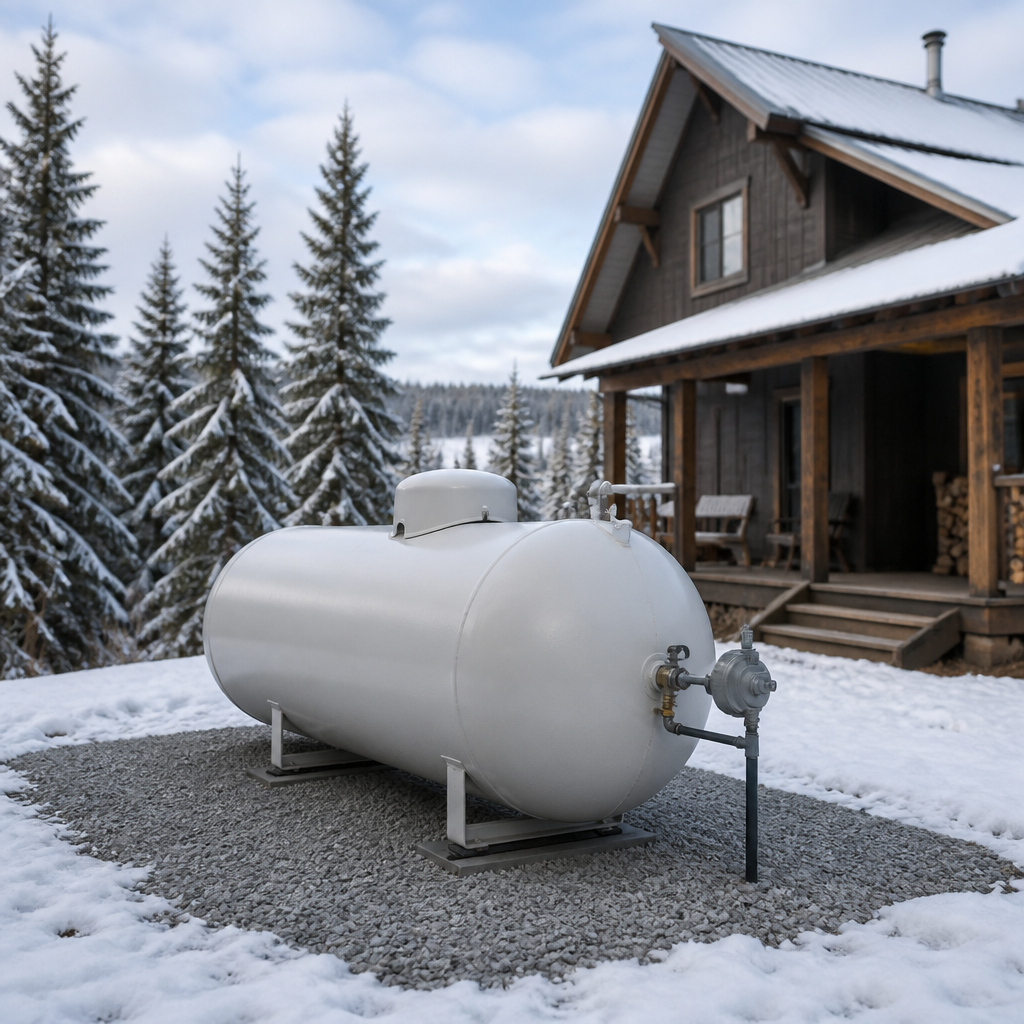
Off-grid propane storage in Canada fails in a predictable way. The tank runs dry during the first hard cold snap, and the cause is almost never the tank itself. The sizing decision was made in spring, when the furnace was barely working and the numbers looked fine on paper. A tank that covers summer cooking can still leave a homestead cold in January. This guide explains how to size a tank from your real winter heating load, where to place it, and what to check before the snow arrives.
Table of Contents
- Quick Takeaways
- Why Tank Sizing Starts With Your Heating Load
- Calculating Days of Autonomy
- Above-Ground Versus Buried Tanks
- Placement and Clearance Rules That Matter
- Winter Operation: Keeping Vapour Flowing
- Winter Safety Checks and Routines
- Refill Timing and Bulk Delivery
- Comparing Common Tank Setups
- Frequently Asked Questions
- References
Quick Takeaways
| Key Insight | Explanation |
|---|---|
| Size from the coldest month, not the annual average | Your tank has to carry the worst two or three weeks of the year. Annual fuel totals hide the January spike that actually empties the tank. |
| Target 30 days of autonomy in deep winter | Thirty days gives you room for storms, blocked roads, and a delayed delivery. Anything under three weeks leaves you one missed truck away from a cold house. |
| Plan on about 80 percent fill, not 100 | Liquid propane expands as it warms. Stopping at roughly 80 percent leaves space for that expansion, so the tank is never filled to the point of overpressure. |
| Watch for frost on the regulator | A frosted regulator means the tank cannot vaporize fuel as fast as your appliances draw it. Reduce the draw, add capacity, or add a second tank before the problem gets worse. |
| Keep snow away from vents, regulators, and fittings | Snow piled against the tank or blocking a regulator vent causes pressure problems and hides leaks. Clear the area after every heavy snowfall. |
| Set your refill trigger at 25 to 30 percent | Deep-winter deliveries slip because of weather and road closures. Ordering early keeps you from running the tank to empty while you wait. |
Why Tank Sizing Starts With Your Heating Load
Start from the heat you need, not from the tank you can afford. Most propane sizing charts ask you to pick a size based on home square footage or the number of appliances. Those tables are a fair starting point for a suburban house with a gas range and a water heater. A remote homestead is different, because heating usually dominates the fuel budget and the building may be drafty, poorly insulated, or sitting on a north-facing slope that bleeds heat all winter.

Tank capacity ranges widely, from 20-pound portable cylinders to containers that hold more than 2,000 gallons. For full-time homesteads with central heat, many suppliers treat a 500-gallon tank as the standard household size. I treat that figure as a floor for planning, not a ceiling. If your cabin burns through a 500-gallon tank in February, a 500-gallon tank is simply too small, no matter what the chart said.
A tank is a fuel reserve, not a heater. The useful question is how many cold days it will carry, not how many gallons it holds.
Estimating your real winter burn rate
The most reliable input is your own history. If you have owned the property through a full winter, look at the delivery records and divide the propane used during the coldest month by the number of days in that month. If you bought the place mid-season, track the tank gauge for two weeks in the coldest stretch you can find and write down the drop each day.
Be honest about the building. A cabin with thin walls, a leaking door, and a vaulted ceiling can burn twice the fuel of a well-sealed house with the same floor area. Before you size anything, spend a weekend sealing drafts around windows and the door, because every BTU you stop losing is a BTU the tank no longer has to supply.
Why appliance count misleads homesteaders
A homestead often has a propane range, a fridge, a water heater, a clothes dryer, and a furnace or heater, and it is tempting to add up the nameplate ratings. Nameplate figures describe the maximum an appliance can draw, not what it draws in a typical week. A furnace rated for a high input will run at a fraction of that most of the time, which is why measuring real consumption beats adding up appliance labels.
Calculating Days of Autonomy
Days of autonomy is the number that matters most in winter. It is the count of cold days your tank can cover before you need a delivery, assuming the truck can reach you. Every other sizing decision flows from that single number, so it is worth doing the arithmetic carefully once and then checking it against your actual fuel use.
Converting gallons into heat
Propane holds roughly 91,500 BTU per US gallon. A 500-gallon tank filled to about 80 percent holds around 400 gallons of liquid, which works out to approximately 36.6 million BTU of stored energy. Most tank sizing charts use US gallons, so convert carefully if your supplier quotes litres or imperial gallons, because the difference is large enough to throw off a winter plan.
The 80 percent figure is not a suggestion. Liquid propane expands as it warms, and a tank filled to the brim has no room for that expansion. Standard practice stops the fill well short of full, which is why the usable fuel in a tank is always less than its rated capacity.
A worked example for a cold cabin
Consider an illustrative cabin that averages 45,000 BTU per hour of heat across a deep winter month. That is 1.08 million BTU per day. If the furnace runs at about 80 percent efficiency, the cabin consumes roughly 1.35 million BTU of propane per day, and the 36.6 million BTU in the tank lasts about 27 days.
That sounds comfortable until the weather turns. If a week of minus 30 degree Celsius nights pushes the average to 60,000 BTU per hour, daily fuel use climbs to about 1.8 million BTU, and the same tank covers only about 20 days. This is why I size to the coldest stretch, not the typical month.
Building in a margin you can trust
My rule for full-time properties is to plan for at least 30 days of autonomy in the coldest month. I also never let the gauge drop below roughly 25 percent without a delivery already booked. That margin costs a little more in tank capacity or in early ordering, and it is far cheaper than a midwinter emergency when the road is closed and the house is dropping toward freezing.
Above-Ground Versus Buried Tanks
Above-ground tanks are the default for most rural Canadian homesteads. They cost less to install, they are easy to inspect, and the delivery driver can see them and reach them in every season. Buried tanks protect the steel from sun and wind, keep the site tidy, and cut down on vandalism, but they cost more, need excavation, and demand more planning around drainage and access.
Neither option is automatically better. The right choice depends on your site, your soil, how much time you will spend on maintenance, and whether you need the tank out of the way for a garden or a building footprint. Ask your installer to show you the access route and the fill point before you commit to a location.
Inspection and corrosion access
An above-ground tank is easy to check, and that is its biggest advantage. Look at the paint, the supports, the fittings, and the ground underneath for signs of water pooling or rust. Basic safety guidance from a Canadian propane retailer lists daily visual checks as a standard habit, and on a remote property I do a walk-around every time I feed the woodstove or check the vehicles.
A buried tank hides its problems. You cannot see corrosion on the underside, and water can collect around the fittings where you will never look. If you go underground, plan a schedule for having the tank inspected by a qualified technician, and do not rely on visual checks alone.
Frost, drainage, and ground conditions for buried tanks
Frost heave is the hidden risk for buried installations. Freezing and thawing soil moves and can stress lines and fittings, so the installer needs to know how your ground behaves in spring. Meltwater drainage matters just as much, because a tank sitting in a shallow pocket will collect water that accelerates corrosion.
Buried tanks also sit in ground that stays warmer and more stable than the air above it. That property matters for winter vapour output, which I cover in the winter operation section, and it is one reason some cold-region homesteaders choose buried tanks for high-demand heating.
Placement and Clearance Rules That Matter
Placement is where most homesteaders take shortcuts, and it is also where the most avoidable hazards live. Safety guidance is consistent on the basics: keep tanks away from heat sources and out of direct sunlight when you can. Those rules are simple to state and easy to ignore when the only flat ground is next to the shed.
The actual clearance distances depend on tank size, your province’s code, the appliances you connect, and the installation drawing from your supplier. I will not quote a specific number here, because a figure that is wrong for your site is worse than no figure at all. Get the required distances in writing before the tank goes in.
Keeping the tank away from heat and sun
Heat sources to avoid include woodstove flues, exhaust vents, dryer vents, and any combustion air intake. A black tank in full summer sun also gets hot enough to raise internal pressure, so a partial shade structure can help where the code allows it. Keep vegetation trimmed back so that brush does not collect against the tank or the regulator.
Access for delivery and emergencies
The truck has to reach the fill point in every season, including after a storm. Plan a driveway route that will not be blocked when the plow piles snow at the end of the lane. If your fill valve sits behind a fence or under a deck, that is a problem to solve now, not in February.
Pro tip: Mark the delivery route and the fill valve with tall stakes or reflective posts that stay visible above the snowpack. A driver who cannot find the fill point will leave, and you will be the one waiting for the next delivery window.
Winter Operation: Keeping Vapour Flowing
Propane boils at about minus 42 degrees Celsius, so the liquid does not freeze in a typical Canadian winter. The real problem is how fast the tank can turn liquid into vapour for your appliances. Vapour production depends on how much liquid is in contact with warm surfaces and on the temperature of the tank itself. As the tank cools, it produces less vapour, and a tank that performed well in October can starve a furnace in February.

Why a cold tank loses output
Vapour is drawn from the surface of the liquid, and the liquid absorbs heat from the air and ground around it to keep vaporizing. In deep cold, the air cannot supply that heat fast enough, so the tank’s output falls. Heavy draw makes the problem worse, because the tank is asked to vaporize fuel faster than it can warm itself.
This is the main reason buried tanks often perform better in long cold snaps. Ground temperature changes slowly, so the tank keeps a more stable heat source than an exposed tank in a wind-chilled yard. Wind on an above-ground tank can strip heat away quickly, which is why placing the tank where it is partly sheltered from prevailing winds is worth the effort.
Recognizing a vapour shortage before it empties your heat
Frost on the regulator is the clearest warning sign. It means the tank is vaporizing fuel faster than it can warm, and the regulator is cooling as a result. Other signs include appliances that cycle on and off, a pilot that goes out during a long run, or a noticeable drop in burner flame strength when the furnace is working hard.
When you see these signs, reduce the draw first if you can. Then look at the long-term fix: a larger tank, a second tank connected through a manifold, or a supplier who can set up a configuration rated for your peak demand. A frosted regulator is a capacity problem, not a nuisance to wipe off and ignore.
Winter Safety Checks and Routines
Winter adds hazards that summer does not. Snow and ice block vents and regulators, and a homesteader trudging out in the dark is far more likely to skip a check. The safest approach is a short, fixed routine that you do the same way every time, so it becomes automatic rather than something you remember when you are cold and tired.
Clearing snow and ice from the tank area
Keep the regulator, vent openings, and fill valve clear after every heavy snowfall. Do not let snow pile against the tank, because a drift can block airflow around the regulator and hide the tank from view. Never use an open flame to thaw a regulator or fitting. Warm water poured gently is the safe option, and patience works just as well.
Ice also creates a fall hazard on the path to the tank. Salt or sand the route you walk to read the gauge and check the fittings, because an injury on a frozen walkway is a bigger threat to a remote household than most people plan for.
Leak checks with soapy water
Propane has a added odour so that leaks can be noticed, but you should not rely on your nose alone, especially when the house is closed up and the furnace is running. Once or twice a season, brush a soapy water solution over fittings and joints and watch for bubbles. Any bubbling means the connection needs attention from a qualified technician before you use the system again.
Install carbon monoxide detectors in the sleeping areas and near the fuel-burning appliances, and test them as part of your routine. A propane leak and a combustion problem are different hazards, and you need protection against both.
Pro tip: Write the gauge reading, the date, and the outdoor temperature on a card taped inside the cabin door. After two weeks you will have a burn-rate record that beats any chart, and you will spot a sudden jump in use before it becomes an emergency.
Refill Timing and Bulk Delivery
The fill level you schedule matters as much as the tank you buy. Set your refill trigger at 25 to 30 percent rather than 10 percent, because deep-winter deliveries slip with weather, road closures, and driver schedules. A tank that is almost empty has no buffer when the delivery is delayed, and the regulator frosts on the last few gallons as the liquid level drops.
Bulk delivery works best when the supplier knows your site. Give them clear directions, mark the fill point, and tell them about any gate, steep grade, or seasonal access issue before the first winter storm. A driver who has been to your property once is far more likely to make the next trip in bad weather.
Setting your refill trigger
Divide the gauge reading by your daily burn rate to get the days of fuel left. If that number is less than the time it takes to get a delivery scheduled and completed, order now. I use the 25 percent trigger because it leaves a week or more of buffer in a typical cold snap, even when the road is slow.
Booking deliveries ahead of the storms
Book your winter fills early, ideally before the first hard frost, and ask the supplier how they handle deliveries during a storm. Ask about minimum delivery quantities and whether they can plan a fill around a forecast cold front. Those questions cost nothing and can save you a missed fill in January.
A small backup supply helps with cooking during a delay, but it is not a substitute for the main tank. Never run a space heater from portable cylinders indoors, because combustion heaters need proper ventilation and an appliance rated for indoor use. If the main tank runs low, call the supplier and treat the situation as an emergency.
Comparing Common Tank Setups
Most rural Canadian homesteads end up with one of three configurations. Each has a clear best fit, and each brings a trade-off you should accept on purpose rather than discover in February. The table below compares them on the points that matter most in winter.

| Setup | Best Fit | Main Trade-off |
|---|---|---|
| Single 500-gallon above-ground tank | Full-time cabins with moderate heat demand and easy delivery access | Vapour output drops in long, hard cold snaps, and one tank sets a hard limit on days of autonomy |
| Buried or partly buried single tank | High-demand heating on sites where you want the tank out of sight and protected from wind | Higher installation cost, harder inspection, and more attention needed to drainage and frost movement |
| Two-tank manifold setup | Larger homesteads with heavy winter draw, or sites that need more autonomy than one tank can give | More equipment to maintain, more clearance planning, and a higher upfront cost |
My recommendation for full-time homesteads
For a full-time property with central heat and a reliable delivery route, I start with a single 500-gallon tank and test it against your real burn rate. If you see frost on the regulator in normal cold weather, or if you cannot hold 30 days of autonomy in the coldest month, move to a manifold setup rather than trying to squeeze more out of one tank. Buried installation makes the most sense when the site is exposed, you have the budget for excavation, and you accept the extra inspection work.
Frequently Asked Questions
How big a propane tank do I need for an off-grid cabin in Canada?
Size the tank from the heating load in your coldest month, and aim for at least 30 days of autonomy at that load. A 500-gallon tank is a common baseline for a full-time homestead with central heat, but a small, well-sealed cabin may need far less. Use your own delivery records or a two-week gauge log to get a number you can trust.
Is a buried propane tank better for winter use?
A buried tank is not automatically better, but it does sit in ground that stays warmer and more stable than exposed air, which helps vapour output in long cold spells. The trade-offs are higher installation cost, harder inspection, and more attention to drainage and frost movement. For many sites an above-ground tank with good shelter from wind performs well enough.
How do I know if my tank is too cold to keep up with demand?
Frost on the regulator is the clearest sign, because it means the tank is vaporizing fuel more slowly than your appliances are drawing it. Other warning signs include appliances cycling on and off, a pilot going out during long runs, and weak burner flame when the furnace is working hard. Reduce the draw first, then plan for more capacity if the problem returns.
What is the minimum distance between a propane tank and my house?
There is no single safe number that applies everywhere. The required clearance depends on tank size, your province’s code, the appliances you connect, and the installation drawing from your supplier. Get the figures in writing from the installer or the local authority before you place the tank.
Can I use portable propane cylinders to heat a cabin during a power outage?
Portable cylinders are not a safe substitute for a properly installed heating system. Combustion heaters need proper ventilation and an appliance rated for indoor use, and running one from a cylinder inside a closed cabin risks carbon monoxide poisoning. If the main system fails, contact your supplier and use the manufacturer’s guidance for any backup heater you own.
Have you sized a propane tank for a winter homestead? I would like to hear what burn rate you measured, how many days of autonomy you planned for, and what surprised you once the real cold arrived.
References
- Canadian guidance on keeping propane tanks away from heat and direct sunlight
- Propane tank safety tips covering clearance, placement, and daily visual checks
- Transport Canada overview of carrying propane cylinders for camping and barbecues
- Overview of propane tank size ranges and how tank size relates to household needs
Leave a Reply