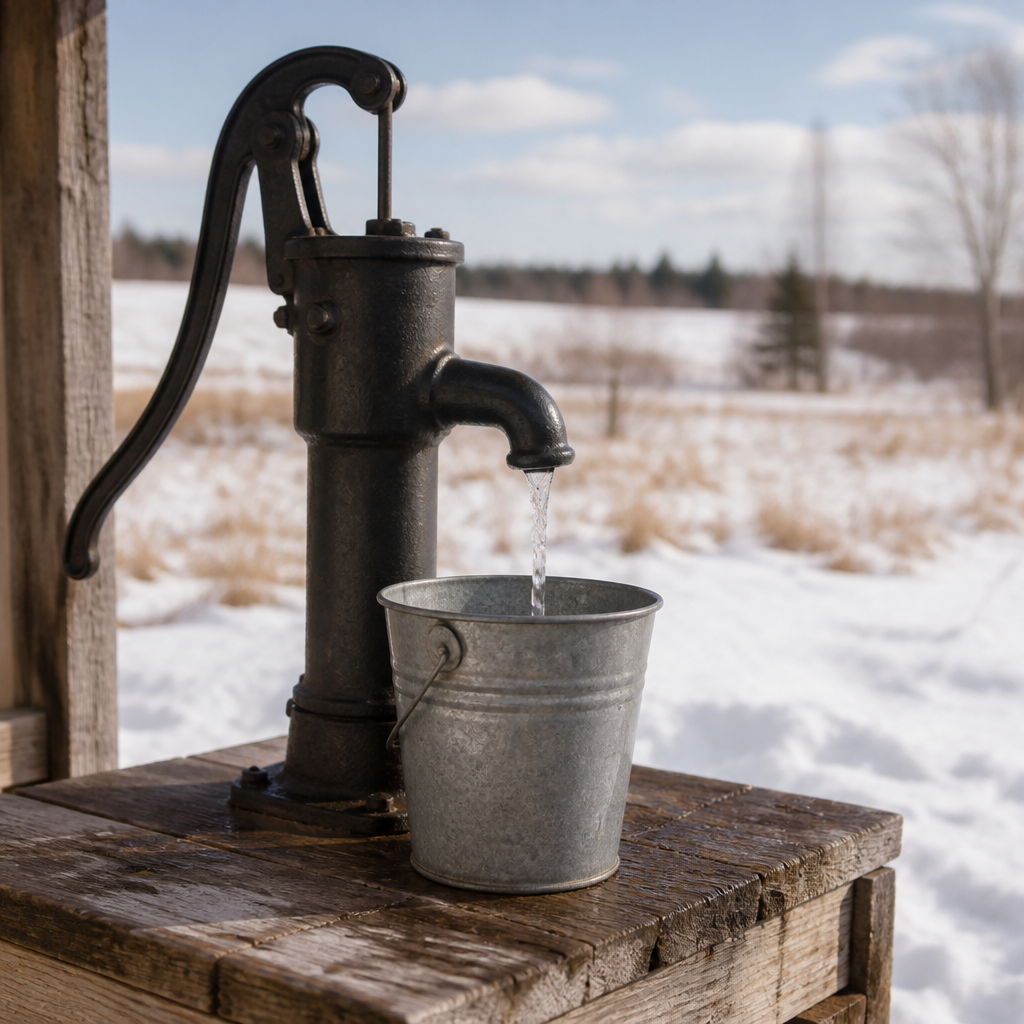
If you are shopping for an off-grid water pump in Canada, the first decision is not the pump itself. It is where the water sits, how far down it is, and what happens to your system when the temperature drops to -30. Plenty of homesteaders buy a pump based on a catalogue photo, then discover in January that the line has frozen, the battery bank is flat, or the well is too deep for the hardware they bought. This guide compares three approaches: manual hand pumps, hydraulic ram pumps, and 12V DC pumps. We cover where each one wins, where it fails, and how to choose for your property.
Table of Contents
- Quick Takeaways
- Hand Pumps for Homestead Use
- Hydraulic Ram Pumps
- 12V DC Pumps and Solar Power
- Comparing the Three Systems
- Installation Mistakes That Cost Water
- Winter Operation in Canadian Conditions
- Frequently Asked Questions
- References
Quick Takeaways
| Key Insight | Explanation |
|---|---|
| Measure static water level first | If the water sits within about 25 feet of the surface, a suction hand pump can reach it. Deeper water needs a deep-setting cylinder, a ram, or a submersible electric or 12V pump. |
| Use a hand pump as backup, not as the only supply | A hand pump costs little and needs no power, but output drops fast with depth and effort. Prime and test it every season so it works on the day you need it. |
| A ram pump needs flow and fall | A hydraulic ram runs on a spring or stream with a usable drop. Measure flow in your driest month, because a creek that dries in August will stop the ram. |
| Size 12V systems from daily litres backward | Divide daily litres by pump flow to get run hours, then convert to amp-hours. Undersized panels and batteries cause more failures than any pump defect. |
| Most small 12V diaphragm pumps are intermittent duty | Do not let them run dry for long. Use a float switch or shutoff in the tank to protect the pump. |
| Plan freeze protection before the first cold snap | Bury lines below your local frost depth, slope them back to the source, and use drain-down valves on exposed runs. |
Hand Pumps for Homestead Use
A hand pump is the only water source on your property that needs no electricity, no fuel, and no sunshine. That makes it the most dependable backup you can install, even if your main supply is an electric submersible. The catch is that a hand pump only works well within a narrow range of depths, and the physical effort climbs fast as the water level drops.

For most Canadian homesteads, the realistic choices are simple. Either the water is shallow enough for a suction pump to reach, or it sits deeper and needs a cylinder set inside the well. Both are worth understanding before you buy hardware.
Shallow Well Suction Pumps
Suction pumps draw water up a pipe by creating a partial vacuum. Atmospheric pressure can only push water up so far, and in practice the limit is around 25 feet of vertical lift at sea level, less at higher elevation and with any leak in the line. If your static water level sits inside that range, a pitcher-style suction pump is cheap, simple to repair, and easy to prime. Most failures I see come from air leaks in the suction line, not from the pump body.
The best use for a shallow-well pump is a garden well, a livestock supply, or a secondary cistern. It fills buckets and barrels without drawing on your power system at all. Mount the handle where you can reach it with snow on the ground.
Deep-Setting Cylinder Pumps
When the water sits beyond suction range, the cylinder goes down into the well and the piston is raised from the surface through a pump rod. Friction on the rod and the weight of the water column make every stroke harder as depth increases. Pumping from 150 feet is physically demanding, and you should expect to rest between sessions. Treat it as an emergency backup, not a daily supply for a household.
Where Hand Pumps Fail
Hand pumps usually fail for reasons unrelated to the pump’s mechanics. Leathers and gaskets dry out over a hot summer and crack when they are finally used. Freeze damage splits exposed spouts and standpipes, and a pump without a drain-down arrangement will crack the first time temperatures fall below freezing. A common mistake is installing a good pump where nobody wants to stand in a blizzard. Put it where you will actually use it.
A hand pump you have never primed is a hand pump that will fail you on the day you need it most.
Pro tip: Prime the pump at least once every season and tag the handle with the date. Pumps that sit for months lose prime and dry out their leathers, which is the most common reason a backup pump looks fine on paper and then fails in practice.
Hydraulic Ram Pumps
A hydraulic ram pump is one of the oldest tricks in off-grid water, and it still earns its keep on properties with a creek or spring above a lower building site. The pump runs on the water itself. Water flows down a drive pipe, a valve slams shut, and the momentum creates a pressure surge that pushes a portion of the water up a delivery line. The cycle repeats many times a minute with no motor, battery, or fuel.
The trade-off is ratio. A ram takes a large volume of water falling a short distance and delivers a much smaller volume lifted a greater height. Most of the inflow exits through the waste valve, so you need a generous supply to get a useful amount uphill.
What Your Site Needs to Work
You need three things: reliable flow, a usable fall between the intake and the pump, and enough distance from the pump to the delivery tank to make the effort worthwhile. A spring that runs all year with a drop of several metres can feed a ram. A stream that shrinks to a trickle by late summer cannot. Measure flow with a bucket and a stopwatch in the driest month, not the wettest one.
Output and What to Expect
Output depends on drop, lift, and flow, and it is nowhere near the rate of an electric pump. Plan for a steady delivery that fills a storage tank over hours rather than a pressurized tap on demand. Most homesteaders pair a ram with a large tank so the system builds a reserve through the day. If you need water instantly, a ram is a supplement, not a replacement.
A ram pump does not create energy. It trades a large volume of water falling a short distance for a smaller volume lifted to a greater height.
Maintenance and Winter Exposure
The valves are the part that wears. The delivery and waste valve seats take constant impact, and a worn seat will change the rhythm of the pump or stop it entirely. Keep a spare valve assembly on hand and inspect the seats each spring. Insulate any drive pipe that runs above ground, and keep the pump housing drained when it is not running, because water freezing inside the body will split castings.
Pro tip: Install a screen or filter at the intake, ahead of the drive pipe. Debris that reaches the valve can jam it open or shut, and a ram that stops in a remote location is often just a clogged screen.
12V DC Pumps and Solar Power
A 12V DC pump is the most flexible option on this list, and the most likely to disappoint if you size it by feel. It runs from a battery bank, which charges from solar panels, wind, or a generator. The pump itself is often the cheapest part of the system. The batteries, panels, wiring, and controller are where the money and the mistakes go.
Matching Pump Flow to Real Daily Use
Start with the water you need each day in litres, then work out how many hours the pump must run to deliver it. Divide the daily volume by the pump’s flow rate to get run time. Multiply the pump’s current draw by that run time to get amp-hours per day, and add a margin for cloudy days and battery losses. Most failures trace back to skipping this arithmetic.
A typical low-cost 12V diaphragm transfer pump, such as the bayite model listed on Amazon, is rated at about 4.5 litres per minute, or roughly 1.2 gallons per minute. That suits filling a tank or a stock trough from a shallow source. It is not a well pump, and it will not lift water from a deep well.
Battery and Panel Sizing in Practice
Solar pumping is a daylight job unless you have a large battery bank. Size the array to deliver your daily amp-hours after derating for winter sun, which in much of Canada is a fraction of summer output. Battery capacity should cover at least one overcast day of pumping. Lead-acid batteries suffer when repeatedly drained deep, so avoid that. Lithium batteries tolerate more cycles but must not be charged below freezing unless they have heating or a cold-charge cutoff.
Diaphragm Versus Submersible 12V Pumps
Diaphragm pumps are self-priming and suit a surface source or a cistern with a short suction line. Most small units are built for intermittent duty, so put a float switch or shutoff in the tank to prevent dry running. Submersible 12V pumps sit in the water and handle longer lifts, but they need a clean intake and a way to pull them for service. Choose by where the water sits, not by which spec looks biggest on the box.
Comparing the Three Systems
No single pump handles every site well, so the right answer depends on three things: depth to water, usable fall, and your solar or battery budget. In practice, the most resilient properties run two systems, such as a solar-powered submersible as the main supply and a deep-setting hand pump on the same well as a fallback. Use the table below as a quick reference.

| Approach | Best Use | Main Drawback |
|---|---|---|
| Hand pump (suction or deep-setting cylinder) | Power-free backup on a reachable well, or a garden and livestock supply | Depends on your physical effort, and output drops fast as the water gets deeper |
| Hydraulic ram pump | Lifting spring or creek water uphill to a tank with no power and no operating cost | Needs steady flow and a usable fall, and sends most of the inflow to waste |
| 12V DC pump with solar and batteries | Filling tanks and running a pressurized supply from a shallow or surface source | Depends on sun, battery health, and careful sizing, and is weakest in deep winter |
My default for a typical rural Canadian property with a drilled well deeper than suction range is a 12V submersible on solar as the primary supply, with a deep-setting cylinder as backup. If the site has a spring above the house, the ram goes first, because its running cost is essentially zero. A suction hand pump only makes sense when the static level is inside that roughly 25-foot limit.
Installation Mistakes That Cost Water
Most off-grid water systems do not fail because the pump is bad. They fail because the plumbing and wiring were treated as an afterthought. The same handful of errors show up again and again, and each one is cheap to avoid during installation and expensive to fix later.
Undersized Suction and Drop Pipes
Narrow pipe adds friction, and friction costs you flow. A line that is too small for the pump will starve it and cause overheating in electric units. Match the pipe diameter to the pump’s specification, and avoid stacking elbows and fittings in the suction line. Every joint is a possible air leak.
Skipping Water Testing Before the Pump Goes In
Test the water before you commit to a pump. Iron, manganese, sediment, and bacteria can damage valves, foul check valves, and coat the inside of a storage tank. A pump pulling sand will wear out far faster than one pulling clear water. If the source is surface water, put treatment ahead of the storage tank, not after it.
Bad Wiring and Voltage Drop on 12V Runs
Low voltage means high current, and high current over a long wire means heat and lost power. On a 12V system, a thin cable from the battery bank to a distant well can rob the pump of enough voltage to stall it. Use wire sized for the run length and current, put a fuse close to the battery, and check voltage at the pump under load, not at rest.
Pro tip: Measure voltage at the pump while it is running, not with the pump off. A reading that looks fine at rest can drop well below rated voltage once the pump draws current, and that is when a pump begins to stutter and overheat.
Winter Operation in Canadian Conditions
Winter is where most Canadian off-grid water systems prove themselves, for better or worse. Cold shortens battery life, freezes exposed pipe, and cuts solar output to a trickle for weeks at a time. Design for the coldest week of the year, not for a mild October afternoon.

Frost Depth and Buried Lines
Bury supply and drop lines below the frost depth for your area, which in many parts of Canada is more than a metre down. Check local frost depth information before you dig, because the figure varies widely from the Prairies to the coast. Any section that surfaces near the house or the wellhead needs insulation and a slope that drains water back toward the source.
Draining Versus Heat Tracing
Draining is the cheapest freeze protection, and it works if the system is designed for it. Use drain-down valves on above-ground runs and choose a pump that can be emptied when temperatures fall. Heat tracing protects long exposed runs, but it draws power, which on an off-grid system means more batteries and more panels. For most small homesteads, a well-designed drain-down beats heat tracing.
Keeping Batteries Working in the Cold
Batteries lose usable capacity as they get colder, and lead-acid batteries are the most sensitive. Keep them in an insulated enclosure that stays above freezing, but not so warm that they age quickly. Lithium batteries should not be charged below freezing, so confirm your battery has a low-temperature charge cutoff or heating before you rely on it in January.
Winter rarely breaks an off-grid water system all at once. It usually breaks the weakest connection first, and that is often a line you forgot to drain.
Pro tip: Keep a simple log of your first and last frost dates and the lowest temperature the system saw each winter. That record shows which parts need protection next year and turns a vague sense of risk into specific fixes.
Frequently Asked Questions
Can a hand pump be my only water source in Canada?
For one person at a cabin with an easy shallow well, it can work. For a household with livestock or a garden, it usually cannot. Use a hand pump as backup for an electric or solar supply, and test it every season so you know the effort required before an emergency.
How deep can an off-grid hand pump reach?
Suction pumps are limited to roughly 25 feet of vertical lift at sea level, and less at altitude or with leaks. Deep-setting cylinder pumps reach much further, but each stroke takes more effort as the water column and rod get longer.
Do hydraulic ram pumps work in winter?
They can, provided water keeps flowing. A ram needs running water through the drive pipe, so ice at the intake or in the valve body will stop it. Insulate exposed sections, keep the intake clear, and drain the pump body before the deep cold arrives.
How do I size solar panels for a 12V pump?
Start with the daily litres you need, divide by the pump’s flow rate to get run hours, then convert that to amp-hours per day using the pump’s current draw. Add a margin for winter sun and cloudy days, and confirm the battery can cover at least one overcast day without deep discharge.
Why does my 12V pump keep losing prime?
The most common cause is an air leak in the suction line, usually at a loose fitting or a cracked hose. Check every joint, make sure the intake stays submerged, and confirm the pump is not running dry when the tank empties.
Can I run a 12V pump straight off my battery bank?
Yes, as long as you use correctly sized wire, a fuse close to the battery, and a controller or switch that stops the pump before the batteries are drained too far. Measure voltage at the pump under load to confirm it gets enough power.
What pump setup is running on your property right now, and where did it first let you down?
References
- Article on manual water pumps for emergency water access
- Product listing for a 12V DC diaphragm water transfer pump
- Discussion thread on farm-style hand pumps for water wells
Leave a Reply