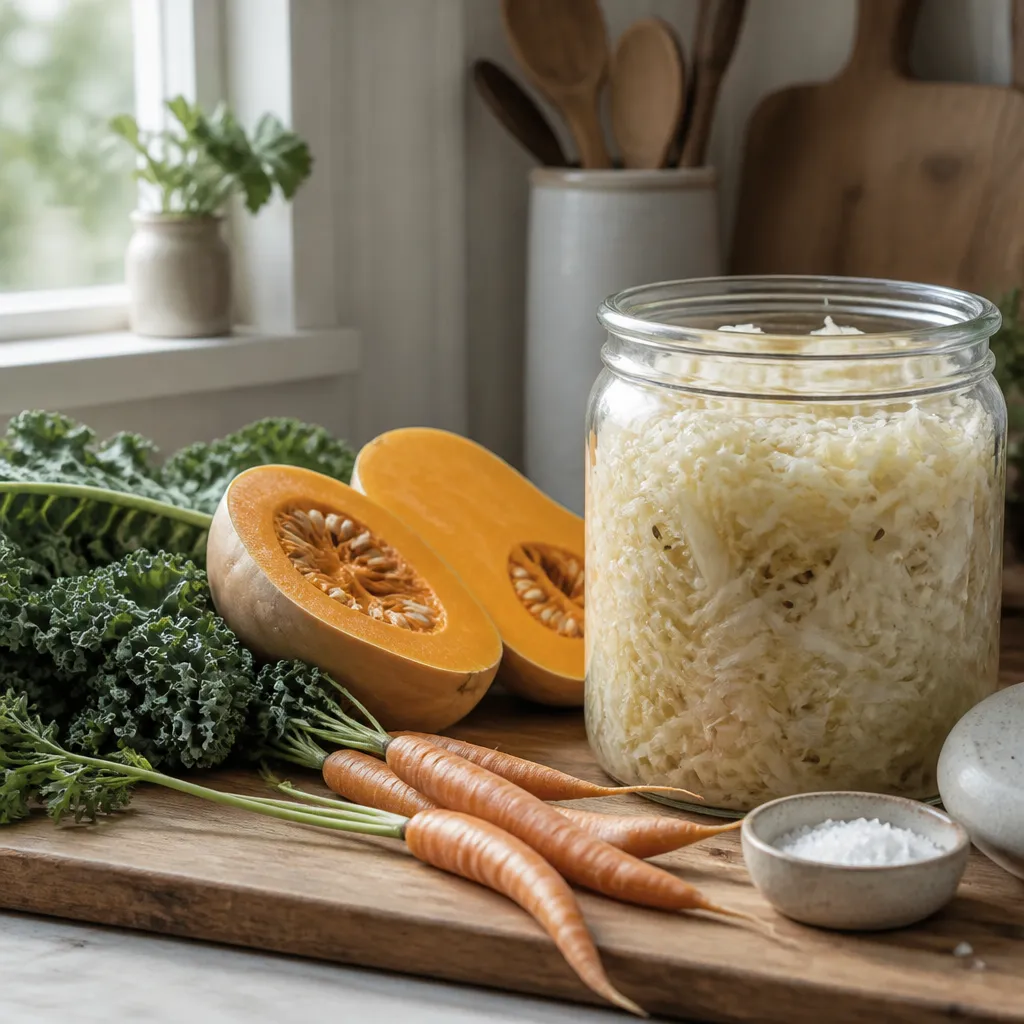
Ask a homesteader what they eat and you will hear about the garden first. Kale in October, squash in January, a crock of sauerkraut on the counter. Those habits usually mean a high-fibre diet, which is good news, but they can also bring bloating and gas, or the opposite problem, a bowel that stops moving. Getting soluble fibre insoluble fibre health right matters because the two types do different jobs once they leave your stomach, and a vegetable-heavy homestead tilts that balance in ways most people never measure. Here is what each type does, how fermented vegetables change the picture, and where the research currently stands.
Table of Contents
- Quick Takeaways
- What Soluble and Insoluble Fibre Actually Do
- Why a High-Vegetable Homestead Pushes Fibre Higher
- Fermented Vegetables and the Microbiome
- Soluble Fibre and Your Gut Bacteria
- Insoluble Fibre, Bulk, and Transit Time
- Comparing Three Homestead Fibre Strategies
- Fibre, Longevity, and What the Evidence Says
- Frequently Asked Questions
- References
Quick Takeaways
| Key Insight | Explanation |
|---|---|
| Soluble fibre forms a gel | It dissolves in water and forms a gel-like material in the stomach that slows digestion. Oats, barley, beans, apples and carrots are good sources. |
| Insoluble fibre adds bulk | It does not dissolve, absorbs fluid and adds bulk to stool, which makes it the first lever to pull when bowel movements are sluggish. |
| Most vegetables contain both | Plan for variety across the week instead of trying to pick one type. Beans and potatoes with skins supply both. |
| Fermented vegetables add more than fibre | Lacto-fermented vegetables supply live microorganisms, and one 2023 study linked regular intake to larger effects on the gut metabolome than on the microbiome. |
| Raise intake in steps | Increase portions over several weeks, and track gas, cramping and stool changes before adding the next serving. |
| Fibre needs water | Fibre that absorbs fluid works poorly on a low-water day. Increase fluid alongside every fibre increase, especially on a rural property where hauling water takes effort. |
| Whole food beats supplements | Psyllium supplies soluble fibre, but a pot of beans or a bowl of oats also delivers vitamins, minerals and food matrix that a powder does not. |
What Soluble and Insoluble Fibre Actually Do
The simplest way to separate the two is by how they behave in water. Soluble fibre dissolves and forms a gel-like material in the stomach that slows digestion, which is why it features in advice about cholesterol and blood sugar. Insoluble fibre does not dissolve, and it supports the movement of material through the digestive system while adding bulk to stool.

How soluble fibre slows things down
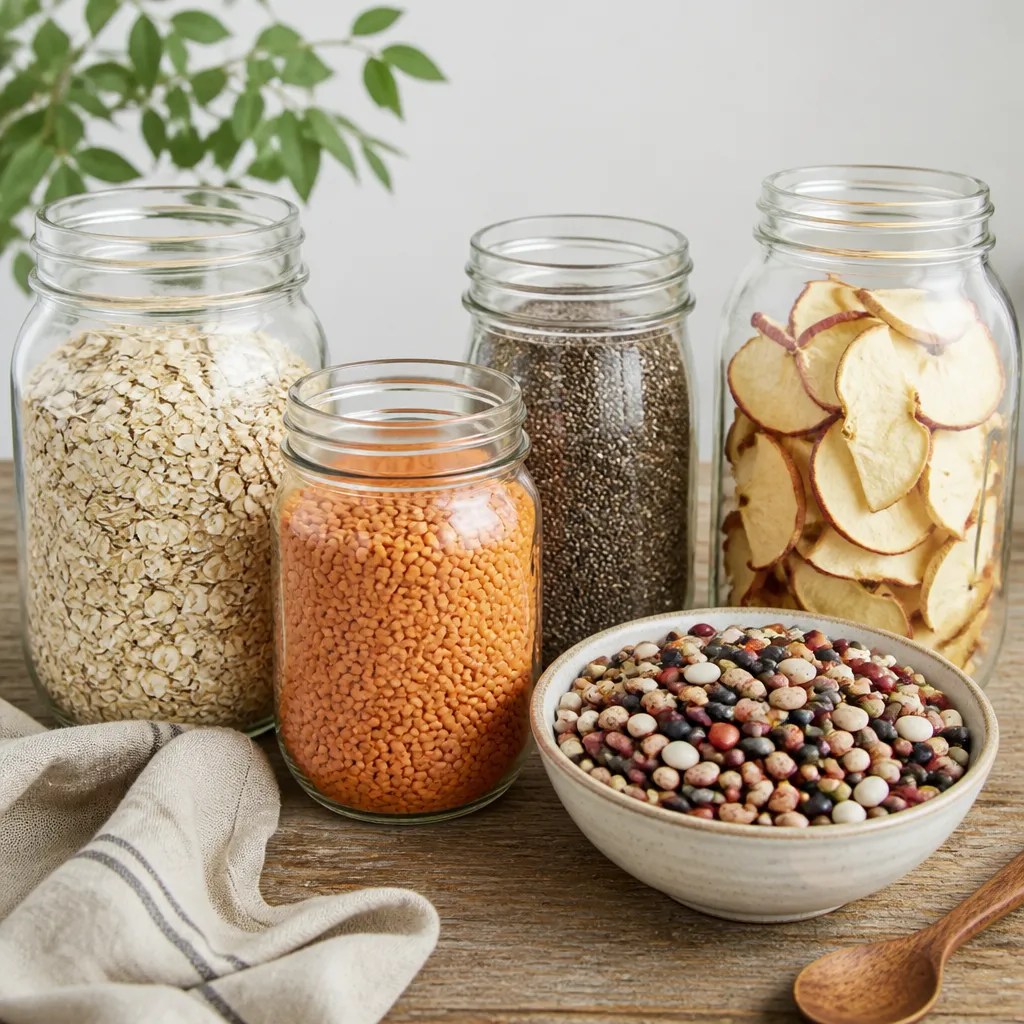
In practice, soluble fibre is the reason a bowl of oatmeal keeps you full through the morning. Mayo Clinic lists oats, peas, beans, apples, bananas, avocados, citrus fruits, carrots, barley and psyllium among its sources. Several of those are easy to produce or store on a homestead, including carrots through winter, dried beans from your own garden and oats bought in bulk.
A common mistake is treating soluble fibre as one thing. Psyllium, the husk sold in capsules and powders, and the soluble fibre in a pot of lentils both slow digestion, but they arrive packaged very differently. Eating the whole food gives you the fibre along with the other nutrients in the same package.
How insoluble fibre moves through the colon
UCLA Health describes insoluble fibre’s main job as bulking up stool. As it passes through the digestive system mostly intact, it absorbs fluid and collects, which gives the contents more mass and makes them easier to move. That mechanism is the reason Mayo Clinic links fibre to a lower chance of constipation, since bulkier stool is generally easier to pass.
Mayo Clinic lists whole-wheat flour, wheat bran, nuts, beans, cauliflower, green beans and potatoes as good sources of insoluble fibre. For a homesteader, the practical point is that much of the insoluble material sits in skins, hulls and stems, which are the parts many people trim away. Potatoes eaten with the skin on are a simple example of a food that does double duty.
Why a High-Vegetable Homestead Pushes Fibre Higher
Most people who move to a homestead eat more fibre within a year without trying. A large share of meals come from the garden, the pantry is stocked with beans and grains bought in bulk, and fewer meals rely on refined flour and packaged snacks. The National Academy of Medicine’s daily targets, as Mayo Clinic summarizes them, are 21 grams for women over 50, 25 grams for women 50 and younger, 30 grams for men over 50 and 38 grams for men 50 and younger.
Few homesteaders count grams. Most of us track whether the garden is producing, which works until winter arrives and the menu narrows to stored squash, potatoes, cabbage and whatever beans were canned in August. That seasonal swing matters because the same household can shift from comfortably high intake in late summer to well below target by February.
Where high-vegetable meals go wrong
The first failure is volume without adjustment. Someone who has eaten a modest side salad for years can suddenly start each day with a large bowl of raw kale, a jar of sauerkraut and a heap of beans, and then spend weeks cramping. Raise intake in steps and watch what your body says before adding the next portion.
The second failure is fluid. Fibre that absorbs water needs water to do its job, and a switch to heavy fibre while drinking very little can backfire. This is the error that trips up many people who are proud of their garden but have not thought about how much water they actually drink on a working day.
Pro tip: Keep a two-week log of what you eat, how much water you drink and how your stools change. Patterns show up quickly, and the log tells you whether the problem is the fibre, the fluid or the speed of the increase.
Fermented Vegetables and the Microbiome
Fermented vegetables sit in a category of their own. A 2025 study in Frontiers in Nutrition by S. Pihelgas compared fresh and fermented vegetable consumption, and the article’s summary notes that fermented vegetables have drawn significant attention for their capacity to modulate the gut microbiota. They are also rich in live microorganisms, which is what separates them from raw or cooked produce that has never been fermented.
A 2023 study by K. Guse, published in Gut Microbiome, reported something more specific. Regular consumption of lacto-fermented vegetables had greater effects on the gut metabolome than on the microbiome. In plain terms, the chemical output of your gut bacteria may shift more than the species mix does, which suggests the benefit may come from what your gut produces rather than from one bacterium you can name.
Lacto-fermenting without special equipment
The USDA Agricultural Research Service notes that fermented vegetables offer an environment where potentially beneficial microbes can grow. At home that usually means a salt brine, vegetables held fully below the liquid, and a container that lets gas escape. Sauerkraut, dilly beans and fermented roots all work without electricity, which is one reason they suit off-grid kitchens.
Salt ratios and temperatures vary by recipe and climate, so follow a tested extension guide rather than improvising. The most common failure is vegetables floating above the brine, where they spoil. Keep everything under the liquid, and discard anything that smells putrid rather than sour.
What fermentation does to the fibre itself
Fermentation does not remove fibre. Much of the plant structure survives, though the texture softens and microbes consume some of the sugars. A jar of kraut therefore delivers fibre along with live microbes in a form many people find easier to digest than the same weight of raw cabbage eaten in one sitting.
Pro tip: Start with a small spoonful of fermented vegetables alongside a meal, then increase slowly. Eating a large bowl on day one is the fastest way to turn a healthy habit into a week of discomfort.
Soluble Fibre and Your Gut Bacteria
A 2021 review in the journal Molecules by Zhi-Wei Guan and co-authors carries the title “Soluble Dietary Fiber, One of the Most Important Nutrients for the Gut Microbiota.” The title makes the central point. Gut bacteria depend on fibre they can break down, and soluble fibre is one of the main fuels available to them, so the fibre you eat shapes what lives and works in your colon.

Oats, barley and beans from your own land
Soluble fibre is where a homestead pantry has a real advantage. Oats, barley and dried beans store well, can be grown on a modest acreage, and keep their soluble content when cooked sensibly. Mayo Clinic lists oats and barley as soluble sources and includes beans in both categories, which makes bean-based stews one of the most useful winter meals you can build.
A practical approach is to cook a large pot of beans once a week and use it across several meals. Beans in chili, soup and grain bowls cost little in fuel when batch cooked, and they keep the soluble fibre in your routine without any special effort.
Why soluble fibre causes gas first
Soluble fibre is the type most often blamed for early bloating, because the bacteria that ferment it produce gas as they work. The fix is not to avoid it. Introduce it slowly, cook beans thoroughly and keep your water intake steady throughout the day.
A common mistake is treating a soluble fibre powder as a shortcut. Psyllium does supply soluble fibre, but it does not replicate the mix of nutrients and food structure in a pot of beans or a bowl of oats. Use it as a targeted tool rather than a substitute for whole food.
Insoluble Fibre, Bulk, and Transit Time
If you struggle to pass stool regularly, insoluble fibre is usually the first lever to pull. Mayo Clinic explains that it supports movement through the digestive system and adds bulk, which is why it can help people who have constipation or do not pass stool regularly. Fibre also softens stool, so the effect runs in both directions depending on what you start with.
Bulk is only half the story. The fibre that moves the most stool is not always the fibre that feeds the most bacteria, and a sound diet needs both.
Bran, whole grains and milling your own flour
Wheat bran is one of the most concentrated sources of insoluble fibre most people encounter, and it is easy to stir into porridge, bread or muffins. Mayo Clinic lists whole-wheat flour and wheat bran among good sources. Home-milled whole-grain flour keeps the bran that white flour removes, which is a useful change for anyone grinding their own grain.
Switching overnight to heavily bran-rich baking is a common mistake. Add it gradually, let the new bread or porridge become routine, and keep the water intake consistent with the change.
Keeping the insoluble parts of your vegetables
Cauliflower, green beans and potatoes all appear on Mayo Clinic’s list of insoluble sources. Keeping potato skins on, using stems in stock and blending tougher greens into soups are simple ways to keep more of the plant. Peeling and trimming everything removes the parts most useful for bulk, so trim only what is truly inedible.
Comparing Three Homestead Fibre Strategies
Most homesteads end up using three approaches at once, whether or not they plan to. The table below compares them on the criteria that matter for gut comfort and for an off-grid kitchen. None of them is a complete answer, and each suits a different season.
| Approach | Fibre Profile | Best Use on a Homestead |
|---|---|---|
| Fresh raw and lightly cooked vegetables | Mostly insoluble fibre, with varying amounts of soluble fibre depending on the plant | Daily base for bulk. Introduce raw cabbage and kale gradually, and cook harder roots to ease digestion. |
| Lacto-fermented vegetables | A mix of both fibre types, plus live microorganisms | Small servings with meals. Stores through the year without power and suits off-grid cooking. |
| Oats, barley and dried beans | Strong soluble fibre content, plus insoluble fibre from whole grains and beans | Winter staples. Batch cook beans and use them across several meals to keep intake steady. |
In practice, I would use fresh vegetables for bulk, ferments for microbial variety, and grains and beans for soluble fibre through the cold months. Trying to get all of your fibre from one category is where most people run into trouble, because each category has a different strength and a different weakness.
Timing also matters. Introduce one new category at a time, give it two or three weeks, and then decide whether to keep it at the same level. Changing all three at once makes it impossible to tell which food caused a problem.
Fibre, Longevity, and What the Evidence Says
Mayo Clinic says foods with fibre can help you stay at a healthy weight and lower the risk of diabetes, heart disease and some types of cancer. Those are the outcomes people usually mean when they talk about fibre and a long life. The honest version is more cautious. Fibre is linked to better long-term health, but no single food or supplement guarantees a longer life.
What the longevity link does and does not prove
Much of the evidence on fibre and long-term health comes from population and observational research. Those studies can show patterns without proving that fibre itself caused a particular outcome. Diet also tends to change alongside other habits, such as how much people move, how well they sleep and how much processed food they eat.
Treat fibre as one dependable part of a broader pattern rather than a magic dose. A homestead that produces fibre-rich food, moves its own water and works outdoors is already stacking several habits together, which is probably why its residents look healthy. The fibre is only one piece of that.
Building a fibre plan you can keep for decades
The best fibre plan for a homestead is one you can keep through a hard winter, a poor harvest or a season of illness. Keep a rotation of fresh, fermented and stored sources, and make sure several of them need no power to prepare. Consistency across years matters far more than a short burst of extra beans.
Some people with existing bowel conditions need to adjust fibre carefully, and a high-fibre plan does not replace medical care. If you have ongoing pain, blood in your stool or a sudden change in bowel habit, speak with a clinician before adding more fibre.
Frequently Asked Questions
What is the difference between soluble and insoluble fibre?
Soluble fibre dissolves in water and forms a gel that slows digestion, while insoluble fibre does not dissolve and adds bulk to stool. Most high-fibre plant foods contain some of both, so variety is the practical goal.
Which type of fibre helps most with constipation?
Insoluble fibre is usually the first lever because it adds bulk and supports movement through the digestive system. Increase your fluid intake at the same time, since fibre that absorbs water works poorly when you are dehydrated.
Are fermented vegetables a useful source of fibre?
They keep much of the plant material from the original vegetable, so they contribute to fibre intake. They also supply live microorganisms, and a 2023 study found regular lacto-fermented vegetable consumption had larger effects on the gut metabolome than on the microbiome.
How much fibre should adults eat each day?
According to the National Academy of Medicine targets summarized by Mayo Clinic, women should aim for 25 grams a day up to age 50 and 21 grams after that, while men should aim for 38 grams up to age 50 and 30 grams after. Build up to those targets over several weeks rather than all at once.
Can a homestead winter pantry supply enough fibre?
Yes, with planning. Oats, dried beans, barley, stored squash and potatoes eaten with the skin on can cover much of the need, but variety matters through the cold months, so rotate stored foods and add some fermented vegetables for texture and microbial diversity.
Is a fibre supplement a good replacement for whole foods?
No. Psyllium supplies soluble fibre, but whole foods deliver fibre together with vitamins, minerals and food structure that a powder does not. Supplements can be a targeted tool, but they should not replace the beans, oats and vegetables that form the core of the diet.
Tell us in the comments what changed first when your garden started filling your plate, and which fibre habit has given you the best results so far.
References
- Review on soluble dietary fibre as a key nutrient for gut microbiota (Molecules, 2021)
- Mayo Clinic guide to dietary fibre types, food sources and daily targets
- UCLA Health overview of soluble fibre and why the body needs it
- Frontiers study comparing fresh and fermented vegetable consumption and gut microbiota
- Gut Microbiome study on lacto-fermented vegetables and the gut metabolome
Leave a Reply